Monday, September 30, 2013

Carlyle to Bid on J&J Diagnostic Unit


Reuters reported:

Some of the world's largest private equity firms have made preliminary offers for Johnson & Johnson's Ortho Clinical Diagnostics unit, which makes blood screening equipment and laboratory blood tests and could fetch around $5 billion, several people familiar with the matter said on Monday.

Blackstone Group LP, KKR & Co LP, Bain Capital LLC, Carlyle Group LP and BC Partners Ltd are among the buyout firms that submitted first-round bids last week and are waiting to hear back this week on who made the shortlist, the sources said.

Recall how KKR's purchase of HCA added tens of billions in new health care costs.  Private equity underwriters are not the balm that heals unaffordable healthcare.  Their aim is to ride discontinuity, enabling them to buy health care assets on the cheap, bleed cash from affiliates via management fees and special distributions, then flip the company for a multiple of the original price.  The flip can be anywhere from 2 to 10 times their original equity.

As for quality I'll pass on any Blackstone, Bain or Carlyle Group blood test or transfusion.  Think Chinese infant formula or toxic kids' jewelry.  

Sunday, September 29, 2013

Income Inequality Due to U.S. Policy: Concordia Kids to Rescue


Washington's Blog ran three posts on inequality recently:

1.  The Stunning Truth About Inequality in America. (click here)
2.  Bad Government Policy Has Created the Worst Inequality on Record...and It's Destroying Our Economy (click here)
3.  Who’s Who of Prominent Economists and Billionaire Investors Say that Runaway Inequality Harms the Economy(click here)

Fortunately, the two young founders of the Concordia Summit held a two day meeting on the topic.  These two pedigreed young men grew up on the prosperous side.  Family and blue blood school connections enabled them to throw together a surprise meeting where President George W. Bush attended in 2011.  President William Jefferson Clinton headlined their event in 2012.

HuffPo reported on the third Concordia Summit:

The next global financial crisis has already started, in the form of nearly 75 million unemployed young people around the world.  If this mass of jobless youth doesn't find work, the consequences will be dramatic, a group of politicians and economists at the Concordia Summit here Friday warned -- from increased violence in the Middle East to ever-higher rates of income inequality in the United States to increased political unrest in Europe.

The article does not mention U.S. policy, emanating from the White House and Capital, produced record income inequality.  It does not say private equity underwriters and their billionaire founders have long had their sights set on public-private partnerships (P3) and have billions in dry powder.

Concordia, a Red team version of the Clinton Global Initiative, plans to lever public money for private gain via P3 expansion.  Note the implied frame:  If the U.S. doesn't P3 for youth employment, even higher rates of income inequality will manifest.  More violence in the Middle East!  These aren't bold predictions, they're the current trajectory.

Might one expect a P3 Fellow to conduct a serious study on public-private partnerships and publish the results?  That wasn't the case when P3 Fellow Daniel Bressler summarized his stint at Concordia.  His fellowship was full of stimulating discussions.

It might be more important to be a jolly-good fellow, one who doesn't make waves or pull back the curtain on the Government-Corporate Monstrosity, Eisenhower's MIC on $ trillions in federal steroids.

At least two youths received serious investment from Concordia.  It remains to be seen how far their wealth grows.  I see a P3 beanstalk for these two Jacks.

Friday, September 27, 2013

CNBC Runs More Ads for Clinton Global Initiative

This looks like a "shhshhh", maybe over the Clinton Global Initiative's past conflicts of interest through overt influence peddling.  Bill Clinton seems able to talk himself out of almost anything.

Or is it into almost anything?
Did Maria buy into the Clinton presence?  Whether she did or did not, CNBC did their part to push the Clinton Global Initiative this week.

CGI is the Blue team's marquee event, held annually in conjunction with the United Nations confab.  The Red team launched The Concordia Summit two years ago, courtesy of two "well connected" young men.  Bill Clinton headlined the Concordia Kids meeting in 2012.

The NYSE took over promotion for the Kids.  Here's the Closing Bell on Thursday, September 26:

The kids are the two gentleman second from either direction, kind of "one off" bookends in the picture.  The NYSE clip showed the Concordia logo in front of a trader.  You can wager on the political Red or Blue team, but you can't buy one share of Concordia.

The NYSE event was the kickoff for the Concordia Summit.  It's clear a number of  global leaders made the trek from the Clinton Global Initiative to the NYSE.  All week long a number of international political leaders graced the Opening and Closing Bell.

Enjoy the spotlight boys.  Some day citizens will wake up to the shameless influence peddling both political parties employ.  It's absurd that two kids right out of college, no matter their esteemed family pedigree, can start a meeting and get a star studded Red Team to show up at short notice.

Leadership does not take ethics (Clinton), experience (Concordia Kids), much less theory/knowledge (both Red & Blue teams).  But they can do marketing/PR and hire their ethically challenged peers.  

Wednesday, September 25, 2013

CNBC Offers 5:00 CGI Commercial


CNBC ran a free five minute ad for President Clinton's foundation, the Clinton Global Initiative, when it interviewed Standard Chartered CEO Peter Sands.  There was nary a word about CGI 2013 or the foundation's conflict of interest concerns. 

Tuesday, September 24, 2013

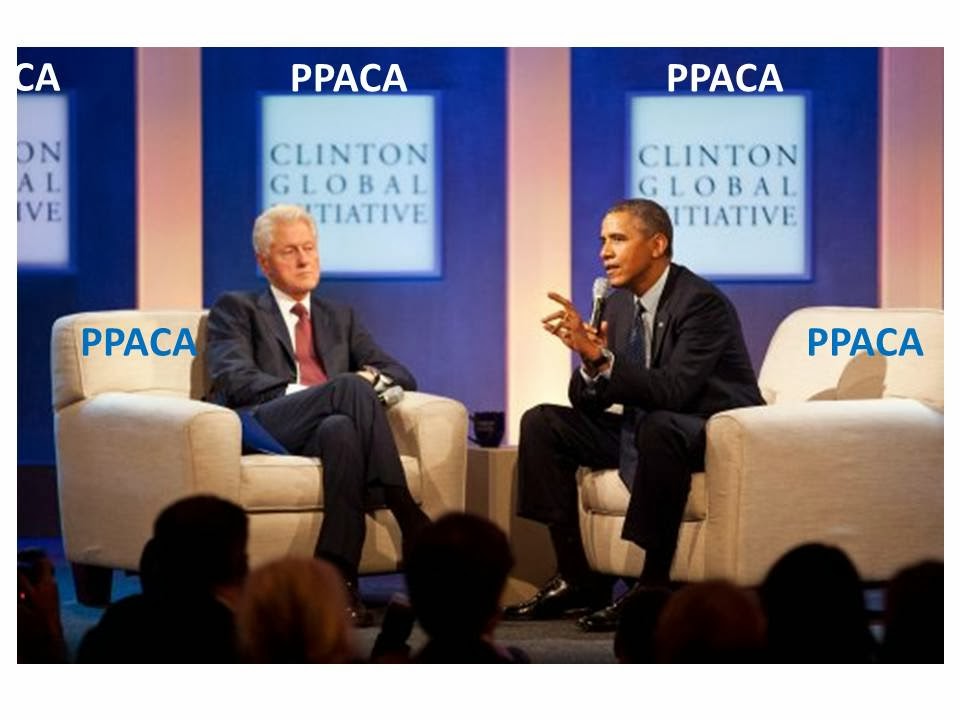
Obama Sells PPACA at CGI

The interchange between Presidents Clinton and Obama was sold this way by the White House (USA Today) :

The president and ex-president Clinton "will engage in a conversation about the benefits and future of health care reform in America and access to quality health care around the globe," said White House spokesman Jay Carney.
The Daily Beast commented on the surreal nature of our public stage:

Could the dialogue about the new health-care law get any more surreal? On one television network, Texas Republican Ted Cruz drones on and on about the evils of Obamacare, and on another, Democratic Presidents Obama and Clinton do their best to sell a skeptical American public on the new health-care law, sounding a bit like the Home Shopping Network as they put in a plug for people to go online to HealthCare.gov and sign up for coverage.
PPACA is surreal on other fronts.  Many corporate over-65 retiree health insurance plans are effectively going defined contribution when companies shift over-65 retirees from their employee group plans to individual Medicare Advantage plans through a private exchange.  This moves retired workers insurance from group plans to individual plans, the exact opposite of what Clinton and Obama stated in their interview.

Obama explained how pooling risk eliminates the expensive cost-shifting when emergency rooms provide care and pass the costs along. He also acknowledged raising taxes—gasp—on higher-income Medicare recipients and on so-called Cadillac plans, which has labor unions in a tizzy, and reducing the subsidies for Medicare Advantage plans.
If the feds are reducing subsidies for Medicare Advantage plans and employers cap their contribution, who does that leave to pick up future increases?  It's the over-65 retired worker.

Obama's statement about pooling risk eliminating expensive ER cost shifting is nonsense.  Pooling risk shares expensive ER costs across a larger group of people.  Benefit design and utilization controls eliminate expensive ER costs by making them the responsibility of the individual for any inappropriate use.

Health care coverage, employer and government provided, is marked by tremendous complexity.  The labyrinth of rules and procedures one must navigate to get coverage is the first hurdle.  The rabbit hole deepens when one needs to access emergency care, see a doctor or obtain a pharmaceutical.  Make a mistake and the penalty can be no coverage. 

Employers simply don’t like to be told they have to provide coverage, and people don’t like to be told they have to have coverage, he said.


Recently released Census data shows employers covering a smaller percentage of Americans.   If employers covered Americans as the same rate under President Clinton (1997), nearly 30 million of the currently uninsured would have coverage today. 

President Obama gave employers an extra year to meet any commitments.  He extended the date employers have to comply with PPACA to January 1, 2014.  The law allows employers to not provide coverage and pay a penalty.  The penalty is a fraction of the amount spent by employers offering a health insurance benefit to workers.

The simple act of dumping employer sponsored health insurance would be a financial boon to the C-Suite in executive incentive compensation.  This is the world we live in, where leaders, corporate and political, lie to people.

PPACA set up the acceleration of the great employer health insurance shedding, already well underway.  It also rejiggered the health care table for private equity underwriters (PEU's) to make billions buying and selling health care companies.  Think KKR and HCA, Cerberus and Caritas Christi Health System, Gentiva and Capstar's Harden Healthcare, CCMP Capital Partner's sale of CareMore to WellPoint.

Obama's White House Health Reformer had PEU origins and returned to her PEU roots after her public service.  Look for Nancy-Ann DeParle's Consonance Capital to lever PPACA to great profit.

Oddly, Nancy-Ann continued to receive private equity distributions from previously undeclared investments while serving in the Obama White House.  No conflicts here.  As P.T. Barnum would say "Move on the to Great Egress." 

Update 9-25-19:  PPACA Report Card:  Employers shifted costs to employees via higher deductibles and increased co-pays.   PPACA has not helped make healthcare more affordable.  It has made a lot of money for the PEU boys. 

Update 4-3-22:   The average health insurance premium more than tripled for a family plan since PPACA passed in 2010.  Cost curve bent but in the wrong direction.  Concave went convex.  

Monday, September 23, 2013

CGI Week Begins Tuesday

The Clinton Global Initiative kicks off tomorrow, fresh from confessing to fiscal transgressions which enriched Clinton associates.  It will be interesting to see if Bill Clinton speaks to this issue during the three day meeting.  While CGI hired big guns for communications, it may not have met fiduciary basics.  PwC might need to do more than teach financial education for Clinton's foundation. 

It's a big week in New York, with the high stakes United Nations' meeting, CGI and the Concordia Kids P4 confab.  I'm not sure the last time this many power brokers were in the same small vicinity.  Maybe the World Economic Forum in Davos.

Update 10-30-16:  ZeroHedge reported just how conflicted CGI is.  Politico did a story as well.

Sunday, September 22, 2013

Harvard's PEU Campaign Co-Chairs


Harvard Magazine identified the nine co-chairs for the university's $6.5 billion fundraising campaign.  Five of the nine are private equity underwriters (PEU's):

1.  Paul J. Finnegan, Madison Dearborn Partners
Paul Finnegan is co-Chief Executive Officer of Madison Dearborn Partners. Prior to co-founding Madison Dearborn Partners, Mr. Finnegan was with First Chicago Venture Capital for ten years.  Mr. Finnegan has more than 30 years of experience in private equity investing with a particular focus on investments in the communications industry.  Mr. Finnegan currently serves on the board of directors of CDW Corporation.    

2.  Glenn Hutchins, Silver Lake Partners
Mr. Hutchins is a co-founder of Silver Lake. He is chairman of the board of SunGard Corp. and a director of the NASDAQ OMX Group, Inc. and Mercury Payment Systems. Mr. Hutchins served President Clinton in both the transition and the White House as a special advisor on economic and health-care policy. He is also a director of the Federal Reserve Bank of New York and Vice Chairman of the Brookings Institution. Mr. Hutchins is a director of the Harvard Management Company, which is responsible for the University’s endowment, and Chairman of the DuBois Institute at Harvard. He is an owner and member of the Executive Committee of the Boston Celtics basketball team. He is also a trustee of the New York-Presbyterian Hospital and a board member of the Economics Club of New York. Mr. Hutchins holds an A.B. from Harvard College, an M.B.A. from Harvard Business School, and a J.D. from Harvard Law School.
3.  Paul Maeder, Highland Capital Partners
As a Founding Partner of Highland, he has over 28 years of experience in venture capital and has served as a director of many public and private companies. He manages Highland’s investments in Avidyne, Bit9, BlueTarp Financial, Imprivata, Rethink Robotics and 2U where he is Board Chair.  Paul was the 2011-2012 Chair of the National Venture Capital Association during the creation and passage of the JOBS Act. He serves on the SEC Advisory Committee on Small and Emerging Companies. 
4.  Diana Nelson, Carlson (privately held conglomerate)

5.  Joseph J. O'Donnell, Centerplate, Inc.

Mr. Joseph O'Donnell founded Boston Culinary Group, Inc. in 1961 and served as its Chairman, Chief Executive Officer and Director. O'Donnell merged concessions giant Boston Culinary Group into Centerplate, Inc.  Mr. O’Donnell also owns Allied Advertising Agency, the leading advertising agency in the motion picture industry.   He also has stakes in movie theaters, ski resorts, and restaurants including John Harvard's Brew House. And he's a partner in the $200 million Westin at the Boston convention center. 

6.  Lisbet Rausing, philanthropist, daughter of Swedish entrepreneur Hans Rausing

7.  James F. Rothenberg, The Capital Group

8.  David M. Rubenstein, co-CEO and co-founder of The Carlyle Group
David M. Rubenstein is a Co-Founder and Co-Chief Executive Officer of The Carlyle Group. Mr. Rubenstein is based in Washington, D.C.  Prior to forming the firm in 1987, Mr. Rubenstein practiced law in Washington, D.C. with Shaw, Pittman, Potts & Trowbridge (now Pillsbury, Winthrop, Shaw Pittman). From 1977 to 1981, during the Carter administration, Mr. Rubenstein was Deputy Assistant to the President for Domestic Policy. From 1975 to 1976, he served as Chief Counsel to the U.S. Senate Judiciary Committee’s Subcommittee on Constitutional Amendments.

9.  Gwill E. York, co-founder Lighthouse Capital Partners

Gwill led the firm's east coast investment activities, managed LP relations and oversaw portfolio management for the first five Lighthouse investment partnerships. She continues to manage Lighthouse's fourth and fifth investment partnerships in conjunction with the firm's partners. While at Lighthouse Gwill sponsored the firm's investments in NxStage Medical, Millennium Pharmaceuticals, DataSage, Sirocco Systems, Corvis, Triton, Ontogeny, StorageNetworks, and Bolt Media. 

This is evidence of private equity's ubiquitousness in today's world.  The business of buying and selling companies has produced massive wealth, which Harvard wants to mine.

Update 5-26-23:  Rubenstein's time on the Harvard Corporation board is coming to an end