Thursday, October 31, 2019

Retirees Aren't Clamoring for PEU Investments


St. Louis Business Journal reported:

Edward Jones CEO and Managing Partner Penny Pennington said her firm's clients are not clamoring for access to investments in private companies but said that could change over time.

Private equity investments, which are less liquid and more risky, historically have been the purview of very wealthy investors and outside the reach of most retail investors. "We're not seeing that demand yet in our marketplace," Pennington said. "Though what we know is what's attractive to ultra-high-net-worth individuals becomes more attractive, and manufacturers look at getting it more into retail investments. So I am hearing a little bit about that, but I think it will take a bit."

Pennington's comments came during an interview with Bloomberg about the economy and the current investing climate. 

As for the risk of private equity investments, Pennington said: "Private equity is illiquid. When you are talking about the need for liquidity, when you are talking about folks getting into a comfortable retirement and needing to produce income, private equity is not set up right now to do that.
Thus private equity investments will need to be dressed in a way that cons the retiree into thinking they have a liquid, predictable income producing asset.   Rest assured it will come with layers of fees.

Harken back to Carlyle Capital Corporation.  Forbes reported Carlyle's sales pitch to Michael Huffington, who sued The Carlyle Group for losing his $20 million investment:

the fund was "conservative,' 'low risk' and that the 'downside [was] very limited"
Huffington was concerned about the safety of private equity underwriters (PEU).

Huffington expressed reservations about the risky nature of private equity, but Rubenstein responded that he would "look for something appropriate for you."
Carlyle Capital Corporation was listed in Amstedam, giving it the appearance of a stable investment.  The mortgage backed security firm was levered 32 times.  Four days ago Carlyle Group co-founder David Rubenstein said on Sunday Morning:

"What we've learned over thousands of years is that history repeats itself," Carlyle Group co-founder David Rubenstein said. "And if you can find the solutions that people came up with or the mistakes they made in trying to deal with these problems, you're probably going to avoid some of the mistakes that people made in the past."
Beware whatever the PEU boys package for retirees needing safe, predictable income.   Someone may be telling you a story. 

Someone has to be the final mark for the greed and leverage boys holding trillions in dry powder.  Beware the spark that makes it go "Boom."

Monday, October 28, 2019

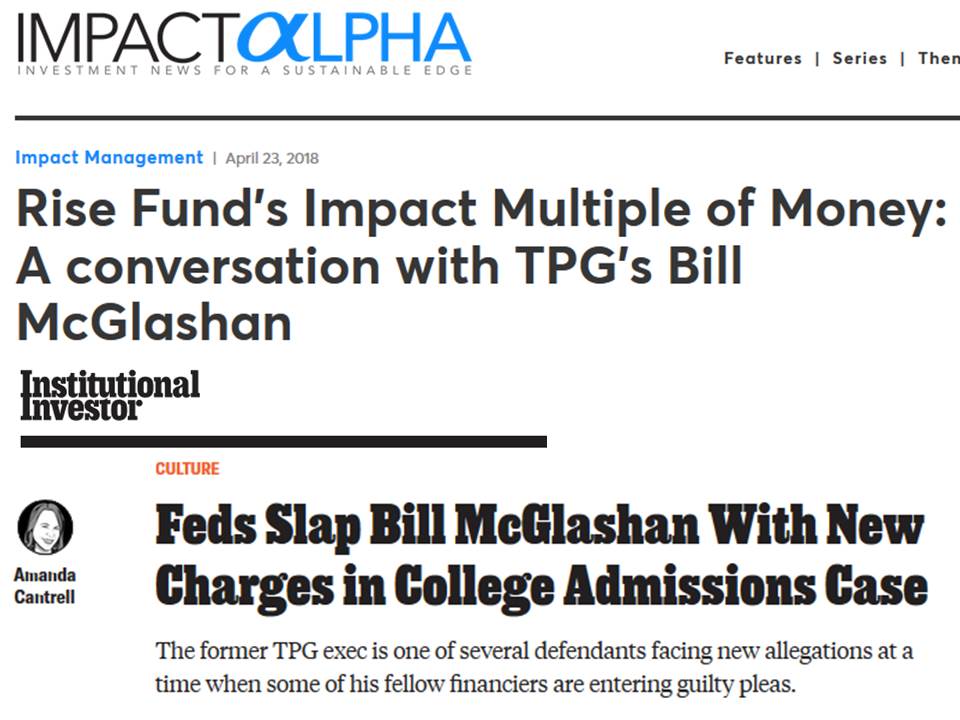
Rise Fund's Bill McGlashan PEU Fall


TPG Capital, a Forth Worth, Texas based private equity underwriter (PEU), targeted social and environmental impact in addition to massive profits in their Rise Fund.  TPG calls that "complete returns."

The Rise Fund, which launched in December 2016, was co-founded by Bill McGlashan, Founder and Managing Partner of TPG Growth and Co-Founder and CEO of The Rise Fund; U2 lead singer Bono, a well-known activist and a special partner with TPG Growth; and Jeff Skoll, a global entrepreneur, film producer, and impact investor. 

“Education is a crucial part of The Rise Fund’s mission. Expanding access to quality education creates a foundation for long-term growth, progress, and prosperity,” said Bill McGlashan. “There is a vast need for improved and expanded educational resources around the world. At the same time, there are exciting opportunities to build innovative and impactful educational businesses and technologies.  
Rise refers to the fund as a "leading global education investor."  Institutional Investor reported:


Bill McGlashan, founder and managing partner at TPG Growth and co-founder of The Rise Fund, a social and environmental impact fund, was accused of allegedly paying bribes to facilitate his children's admission to colleges, federal prosecutors said.

Institutional Investor later added:

TPG was a few months into fundraising for Rise Fund II when co-founder McGlashan was accused of bribing a University of Southern California official to facilitate his son’s admission to the school as a recruited athlete.
CNBC reported Rise co-founder McGlashin was either fired for cause or quit:

“After reviewing the allegations of personal misconduct in the criminal complaint, we believe the behavior described to be inexcusable and antithetical to the values of our entire organization."

McGlashan is disputing the terms of his departure, saying he resigned.
TPG co-founder David Bonderman made a sexist remark at an Uber board meeting which caused his resignation from the Uber board.  I am not aware of any funds pulled from TPG as a result of Bonderman's comment to fellow board member Arianna Huffington.

The impact of McGlashin's actions has not hurt Rise Fund fundraising.  Rise Fund II is at $1.7 billion with a target of $2.5 billion.  Contrast this with Ken Fisher of Fisher Investments.  Pensions and Investments reported:

The toll exacted by asset owners for Kenneth L. Fisher's sexist comments made at a conference earlier this month is $3 billion and counting.
The same groups put money into Rise and Fisher investments.   How does one firm get a free pass while the other gets pummeled?  The big money boys will have to answer. 

It's like the Dubai Ports World brouhaha where the prospect of American ports falling into Middle Eastern hands caused a giant uproar.  Shortly after that The Carlyle Group sold fifty U.S. airport operations to Dubai Aerospace and there was not one peep in the media.  

It's a rising PEU world, even as one of their stars fell. 

Saturday, October 26, 2019

Business School Tale Has PEU Odor


A Duke University law professor questioned the purpose of private equity. 

"private equity emerged as a knight in shining armor, reuniting ownership and control in corporate America and turning bloated, inefficient companies into slimmed-down cash machines."
Her thesis is private equity underwriter's (PEU) original purpose was to reform corporate governance.  PEU ownership turned the board into an insider group laser focused on returning large amounts of cash to sponsor via deal fees, management fees, special dividends/distributions and finally flipping the company for a multiple of its original purchase price.  Along the way sponsor PEU placed as little up front cash in the project (equity), saddling the company with massive debt relative to its prior inefficient public ownership.

The professor cites how the corporate world has changed and stated private equity's current distinctive competency might be providing "cheap debt" to companies.  I am not sure that is true as riskier junk bonds pay more in interest than investment grade bonds.  Most private equity transactions are not investment grade so they pay higher interest rates.

Cheap debt is a function of The Federal Reserve Bank and top leaders Jay Powell and Randall Quarles are former PEU boys.  Both worked for Washington, D.C. based The Carlyle Group.

One frequent spinner of the "knight in shining armor" story is Carlyle Group co-founder David Rubenstein.  He sat on the Duke University board until from 2005-2017, serving the last four years as board chair and made significant contributions to a number of Duke programs.  Rubenstein has his own Duke University webpage.


Do knights in shining armor lead on a family owned company, only to foreclose via highly discounted debt?  The deal jettisoned the employee pension.  That's the Carlyle Brintons story.

Do rescuing knights get banned from the World Bank for 33 months for procurement violations?  That's Carlyle and ARINC.

Do knights go bankrupt from bad financial bets not revealed in SEC filings?  That's Carlyle and Semgroup.

There are many more black knight PEU stories for Carlyle.  Older examples include LifeCare, Manorcare, Vought Aircraft, and Synagro.  The newest is Carlyle's abandonment of the Corpus Christi Harbor Island oil terminal.

I don't believe the greed and leverage boys were ever knights in shining armor, not in the '80's and not today.  They are obsessed with image and utilize every lever to shape the world to their advantage.

Rather than White Knight private equity is more like a Great White Shark.  The PEU appetite for money is insatiable.  Watch out for financial sharks when they gather in groups at Davos in Desert, like their great white counterparts, currently off North Carolina's Outer Banks.

Thursday, October 24, 2019

Washington's Blog Ending


Washington's Blog will cease operation at the end of October.  I will miss a cohort in reigning in the out-sized influence of private equity in our country.  Washington's Blog stated:

We are not calling for lawlessness. We are calling for an end to lawlessness and lack of accountability and a return to the rule of law. 

Rather than trying to subvert the constitution, we are calling for its enforcement.

We are patriotic Americans born and raised in this country. We love the U.S. We don't seek to destroy or attack America ... we seek to restore her to strength, prosperity, liberty and respect.
And that strength comes from an aware electorate.  I recall September 2008 trying to understand how an economy could be taken to its knees by the failure of a few financial firms.  Washington's Blog delved into the crisis, as did I.

PEUReport began in July 2007 after noticing preferential treatment given to The Carlyle Group in its sale of Landmark Aviation (the first time) and Standard Aero to Dubai Aerospace.  Washington's Blog archives show a similar time start.  

I appreciate the good fight Washington's Blog gave, even as junk statistics smeared their reputation to give Hillary Clinton a better night's sleep.  Unfortunately politicians red and blue love PEU (private equity underwriters).  Fighting the PEU stain means taking on their sponsored politicians.  It's a daunting effort, one made better by numbers.  

Thank you, Washington's Blog from PEUReport.

Wednesday, October 23, 2019

Jilted Berry Drops Lawsuit Against Carlyle Group


Shipping media sources referred to Carlyle's abandonment of a $1 billion crude oil shipping facility in Corpus Christi:  (Tradewinds, Lloyd's, Big and Kallanish)


Drops out, quits, dissolves.  The change in language is noticeably different from the announcement in which Carlyle "agreed to lead the construction and ongoing operations of the Terminal on an exclusive basis".

Exclusive turned into a joint venture with The Berry Group, which became a solo deal without Carlyle.  

How many companies drop a lawsuit after failing to reach an amicable separation?  Isn't that the purpose of a lawsuit?  The Berry Group and Lone Star Ports let Carlyle (with its $223 billion in AUM) off the hook..  

It's a move reminiscent of The Carlyle Group's abandonment of nursing home giant ManorCare.  In that case Carlyle handed the company over to debtholders, not a joint venture partner.

It would appear Carlyle foisted its equity stake on Berry.  How many government agencies will trust Carlyle to carry the ball on infrastructure projects going forward?  How many will trust Carlyle as a potential partner?

Update 11-2-19:  Corpus Christi BizNews reported Berry and Carlyle reached a settlement on the lawsuit.

Saturday, October 19, 2019

Port of Corpus Christi gets PEU'd by Carlyle


Last year The Carlyle Group announced it would develop a new oil export terminal for the Port of Corpus Christi.  Carlyle's website stated:

Under the terms of the Agreement, the Port will work exclusively with Carlyle to bring together world-class oil producers, marketers, pipeline operators and marine terminal operators to ensure a significant portion of the new oil production in Texas will have a reliable gateway to international markets. As part of the Agreement, Carlyle agreed to lead the construction and ongoing operations of the Terminal on an exclusive basis. Carlyle also agreed that it would arrange for a private funding solution for a dredging project to bring fully-laden VLCCs to Harbor Island (at least a 75-foot main channel depth).

The Terminal is expected to be operational in late 2020. Carlyle’s equity for this investment will come from its Global Infrastructure Fund. 
Reuter's reported that Carlyle is out of the Corpus Christi project, as did the Corpus Christi Caller Times and KRIS TV.  Carlyle's joint venture signed a fifty year lease with the Port in March.

The Port of Corpus Christi Port Commission met on October 15 and the board packet made no mention of The Carlyle Group.  The agenda had the following item for Lone Star Ports, the joint venture between Carlyle and The Berry Group:

Receive legal advice from PCCA's counsel in connection with Lease Agreement between the PCCA and Lone Star Ports, LLC
That was in executive session. The Port's September commission packet had this agenda item for Lone Star Ports (before Carlyle officially pulled out).

10h. Professional Engineering Services Contract with Schneider Electric: Staff recommended approval, in the form presented to the meeting, of a Professional Engineering Services Contract with Schneider Electric in an amount not to exceed $251,502 to provide the engineering services necessary to assess facts and optimal power choices to meet Lone Star Ports’ project schedule, cost, resilience, and sustainability options at Harbor Island.
Schneider Electric and The Carlyle Group announced a partnership/joint venture in April:

Global investment firm, The Carlyle Group (NASDAQ: CG) and Schneider Electric SE (EPA: SU), the leader in the digital transformation of energy management and automation, today announced the enhancement of their partnership to develop new and innovative infrastructure projects. 

In addition to creating new investment and energy-as-a-service opportunities, this collaboration will apply Schneider Electric’s capabilities in advanced connectivity and real-time insights to current and future Carlyle infrastructure and microgrid investments. In a market which faced sustained underinvestment in critical infrastructure due to funding constraints, the new partnership will offer innovative and efficient solutions meeting the needs of a rapidly changing energy landscape. 

The Carlyle Group recently announced several large infrastructure projects, including the JFK Airport Terminal One Redevelopment, Munich Airport Joint Venture (Reach Airports) and Lone Star Ports Harbor Island Crude Export Terminal, which are expected to benefit from this partnership and Schneider’s breadth of technology-enabled products, solutions and services. 

The new partnership also entails the formation of a joint venture, named AlphaStruxure to drive from the design and engineering phase the development of smarter infrastructure projects and more reliable distributed energy and microgrid networks.  
Carlyle cut its teeth on government contractors, has connections to leverage Uncle Sam's checkbook and learned long ago to layer businesses.  It also knows how to contain responsibility and liability, which makes it easier to abandon a project once profits aren't big enough or public opposition gets too great.  The Carlyle Group embodies greed and leverage.  They pulled out when they couldn't get enough of either.


Corpus isn't alone in Carlyle abandoning a project they'd started. Boise, Idaho had a similar experience with its tank farm project.

Update 10-30-19:  Hellenic Shipping News reported "Carlyle quit the venture without providing a reason.  Ferris Hussein, a Carlyle managing director, declined to comment on the reason for its withdrawal.

Update 1-14-22:  After bailing as lead developer for Harbor Island Carlyle plans to start a new infrastructure offering.  Time to mine more of Uncle Sam's wallet?

Tuesday, October 8, 2019

Denka Executives Dishonor Cancer Victims


The Guardian reported:

Residents of Reserve, Louisiana aimed to present evidence to Denka that its plant’s toxic emissions are responsible for high rates of cancer in their town.

Lydia Gerard and Robert Taylor never came close to losing their composure, even when it became clear that that their 7,000-mile journey from the southern United States to Japan was about to come to nought.

Denied even the courtesy of a brief meeting – in a country fabled for its levels of civility – with representatives of a Japanese company they blame for spewing a toxic chemical into the air above their home town, they listened patiently as uniformed guards repeatedly told them to turn around and leave – immediately.
Denka executives dishonored their visitors from Cancer Town, USA, as they pursue medical ventures.


Denka's President prioritized private equity underwriting (PEU) over basic courtesy.


That's not sound social development.  It's the way of the word-twisting greed and leverage boys.