Showing posts sorted by date for query caritas. Sort by relevance Show all posts

Friday, September 27, 2024

Who Serves Who in our PEU World?


Two hearings shed light into the proverbial darkness of outsized political influence.  The first involved the U.S. Senate where Caritas Christi/Steward Healthcare CEO Ralph de la Torre, MD was a no show for his subpoenaed testimony.  

Flashback to 2016 when private equity owner Cerberus had a giant profitgasm.  NYPost reported:

Cerberus received $719 million of the dividend while the remaining $71 million was paid to the Steward management team headed by CEO Dr. Ralph de la Torre.
Private equity underwriters (PEU) spawned the term "policy making billionaire" back in 2011.  

...the new philanthropists share a disdain for established politics and an impatience with the slow churn of old-fashioned policy making.
And how have PEU political donations changed since 2011?   They're way up:


I am not surprised that a PEU might skip an uncomfortable hearing with the people who repeatedly saved their highly unpopular, preferred "carried interest" taxation for the last decade and a half.  

Heck, at least two members of the committee, Red Team Senators Mitt Romney and Tommy Tuberville are former PEUs.

What else changed in healthcare since 2011?  Accountable Care Organizations came into being.  PEU Cerberus cited forming an integrated accountable care organization in its rationale for buying Caritas Christi and forming Steward.

Another change is the mass migration of U.S. healthcare companies to private equity ownership.


Let that sink in...50% of the healthcare industry is owned by private equity.  That means lots of deals.  Oddly, one man behind the Affordable Care Act, Peter Orszag, is now head of Lazard.  Their website states:

Lazard is one of the world's leading advisors on mergers, acquisitions, divestitures and related strategic matters.
Orszag changed his tune on healthcare antitrust after joining Lazard.  Consider his shift:

So Peter wanted healthcare to be overrun by private equity underwriters?  That's quite the admission.  Fortunately, a judge came to the PEU rescue and stemmed any antitrust overreach.  Peter can get back to wheeler-dealing PEU style.  His brother Jonathon can advise groups involved in both sides of an antitrust fight.

Let's tackle the second hearing.


Billionaires can "buy a Congressman" and make their problems go away.  

Who serves who in our PEU world?  Politicians Red and Blue love PEU and increasingly, more are one.  Nearly every former Medicare Chief is a PEU.  

It's no wonder people feel the healthcare system is not serving them.  An accountability mechanism does not exist.  Right Dr. Ralph de la Torre?  

Right Tom Scully?  Scully is the former Medicare Chief who refused to testify before Congress and went on to General Partner with PEU Welsh Carson Anderson and Stowe.  WCAS just benefited from that recent antitrust ruling.

Update 10-2-24:  Lazard's Peter Orszag was on CNBC this morning bemoaning the FTC's antitrust focus on vertical intergration (PEU buyouts).

Sunday, October 2, 2016

PEU Cerberus Selling Caritas Christi Hospital Facilities: Will Hold Free Shares


Cerberus Capital Management's Steward Health Care will monetize it's buyout of Caritas Christi Health System by selling the hospital facilities to a healthcare real estate investment trust for $1.25 billion.  Private equity underwriter (PEU) Cerberus purchased the Catholic healthcare system nearly six years ago in a $895 million transaction.  Part of the $895 million was a promise to invest in facilities, provide catch up funding for the employee pension plan and repay existing debt.

This isn't the first asset sale/leaseback deal for Steward.  In 2012:

"... it got a cash infusion by selling 13 medical buildings to Healthcare Trust of America, an Arizona real estate investment trust, for about $100 million, agreeing to lease back space." 
It's not clear what Steward did with the $100 million.  Did it stay in the system for capital expenditures or did Cerberus get a fat dividend?

Steward's current value is $2.2 billion, $1.2 billion for hospital facilities it plans to sell/leaseback and $1 billion for the revenue stream and assets left after the facility sale.  The $1 billion valuation for the system without actual buildings came from the 5% equity stake Cerberus sold Medical Properties Trust for $50 million.  That equates to a 100% valuation of $1 billion for Steward without walls.

Steward CEO Ralph de la Torre and other senior leaders can benefit from the facility sale:

The deal, which is expected to close during the next quarter, is also designed to allow top Steward leaders to have a “substantially larger stake” in the company.
This looks and smells like reward from Cerberus as it will own Steward with free money.

The entire initial investment to Cerberus will be paid back, but the amount is proprietary, de la Torre said. The deal will also pay down all of the company’s $400 million in debt, he said. 
No one shared how much Cerberus made in deal fees or annual management fees since November 2011.

All this occurred under PPACA, widely known as ObamaCare.  PEU hellhound Cerberus/Steward will pocket $1.3 billion from its asset sale-leaseback trickery, $1.2 billion for hospitals and $100 million for medical office buildings.

The question is how this washes through Steward's Medicare cost reports and impacts money paid the system by Medicare and Medicaid.  Outside Medicare's byzantine "pay for performance" schedules is there a legacy facility component? Surely a revenue cycle number cruncher has modeled the financial benefits of the deal on Medicare reimbursement.  Is that the reason some facilities are leased and others are mortgaged? 

Only 20% of Steward employees on GlassDoor approve of CEO Ralph de la Torre.  The other 80% know they're there to follow orders, meet financial hard targets and enrich executives and their PEU sponsor.

Cerberus ownership of Caritas Christi is a window into today's healthcare world, where prices soar courtesy of greedy leaders.

Cerberus will eventually sell the mostly asset-less Steward Health and executives will get their final cash reward.  Let's hope Catholic leaders, who sold them Caritas Christi, inform them they cannot take their millions or billions with them.  The bills and their dollar signs stay here.  Their deeds however go with them.

PEU Report posts on Cerberus-Caritas Christi
State of the Division posts on Cerberus-Caritas Christi

Update 2-18-17:  Steward needs more hospitals to bleed.  Debt bloated Community Health Systems will sell eight hospitals in three states to Steward.  So far there's no purchase price but CHS is a public company and their shareholders have a right to know.  CHS employees should know only 18% of Steward's employees approve of their CEO on Glassdoor.

Update 1-26-24:  American Prospect summarized the damage Cerberus and Steward Healthcare did to Massachusetts hospitals.  Steward hired a restructuring advisor and may be headed to bankruptcy.

Saturday, March 29, 2014

Architect Ezekial Emanuel Finally Pulls PPACA Curtain

"Step right up, Ladies and Gentlemen.  Witness the blue-chip employer Great Health Insurance shedding.  Watch Captains of Industry slither from past promises.  Dare to look as they gnash on retirees' pocketbooks!"

NYT's You're the Boss:  The Agenda shared a prediction by Ezekial Emanuel, M.D., a paid advisor to the Obama White House on health reform (PPACA):

By 2025, “fewer than 20 percent of workers in the private sector will receive traditional employer-sponsored health insurance.” The source of this claim? Dr. Ezekiel J. Emanuel, in his just-published book, “Reinventing American Health Care.” 

Dr. Emanuel is an accomplished oncologist, medical ethicist and academic (and contributing opinion writer to The New York Times). And, of course, he’s no stranger to politics: He helped craft the Affordable Care Act as a health policy adviser to the Obama administration

Mr. Emanuel argues that in the next two or three years, “a few big, blue-chip companies will announce their intention to stop providing health insurance. Instead, they will raise salaries substantially or offer large, defined contributions to their workers. Then the floodgates will open.” He says that few small businesses will join the SHOP exchanges set up for them and that most of those that offer coverage are even more likely than big companies to drop it, since those who employ fewer than 50 workers face no mandate to offer it in the first place, which Mr. Emanuel thinks is fine.
How kind of Dr. Emanuel to reveal the end game for PPACA.  It is five years after my prediction.

I believe reform sets the table for employers to shed that pesky health insurance benefit.
Many big, blue chip employers recently jettisoned retirees from their health plan, foisting them into individual exchanges with a defined contribution.  PPACA provided $5 billion to employers to encourage maintaining early retiree health coverage.  Over $2 million went to the owner of Newport News Shipbuilding, which later dumped their over 65 retirees onto an exchange.   Other companies jettisoning retirees include:

IBM, TimeWarner, Energizer, DuPont, GM, Ford, Honeywell, 3M and Caterpillar 
These are big, blue chip companies who already did to retirees what Emanual states they'll do to their employees.

Presidents Obama and Clinton got together to push PPACA last year.  I wrote:

PPACA set up the acceleration of the great employer health insurance shedding, already well underway.  It also rejiggered the health care table for private equity underwriters (PEU's) to make billions buying and selling health care companies.  Think KKR and HCA, Cerberus and Caritas Christi Health System, Gentiva and Capstar's Harden Healthcare, CCMP Capital Partner's sale of CareMore to WellPoint. 
Obama's White House Health Reformer had PEU origins and returned to her PEU roots after her public service.  Look for Nancy-Ann DeParle's Consonance Capital to lever PPACA to great profit. 
Oddly, Nancy-Ann continued to receive private equity distributions from previously undeclared investments while serving in the Obama White House.  No conflicts here.  As P.T. Barnum would say "Move on the to Great Egress."

The Great Egress is where employer sponsored health insurance is going.  President Obama's advisors finally told us so, five years after implementing the game plan.

Catch Ezekial Emanuel on CNBC Sunday to hear it from the barker's mouth.

Update 11-16-14:   CNBC reported PPACA's future could include "Employees may experience up to a $6,150 reduction in their health-care benefits and little or no increase in their pay."

Update 12-8-14:  Ezekial laid the groundwork for the government to stop paying for medicines and treatments for people 75 and older.  Pretty easy for a 57 year old to say.

Update 6-18-17:  Ex-President Obama accepted $400,000 to speak for one hour at Cantor Fitzgerald's healthcare conference this September.  The man who turned health care further into a for-profit wasteland is getting his payback.

Update 3-15-18:   Skyhigh healthcare costs differentiate the U.S. from the rest of the globe.  PPACA's cost curve bent in the wrong direction, acceleration.

Update 7-4-19:   Health equity declined since 1993 despite PPACA's promises.

Update 9-25-19:  Employers shifted costs to employees via higher deductibles and increased co-pays.   PPACA has not helped make healthcare more affordable.  It has made a lot of money for the PEU boys.

Update 4-16-20:  A coronavirus pandemic revealed America's broken healthcare system and PPACA's many shortcomings. How many  22 million newly unemployed  can afford the premiums?  How many of these will get COVID-19 and die at home without proper care?  

Tuesday, September 24, 2013

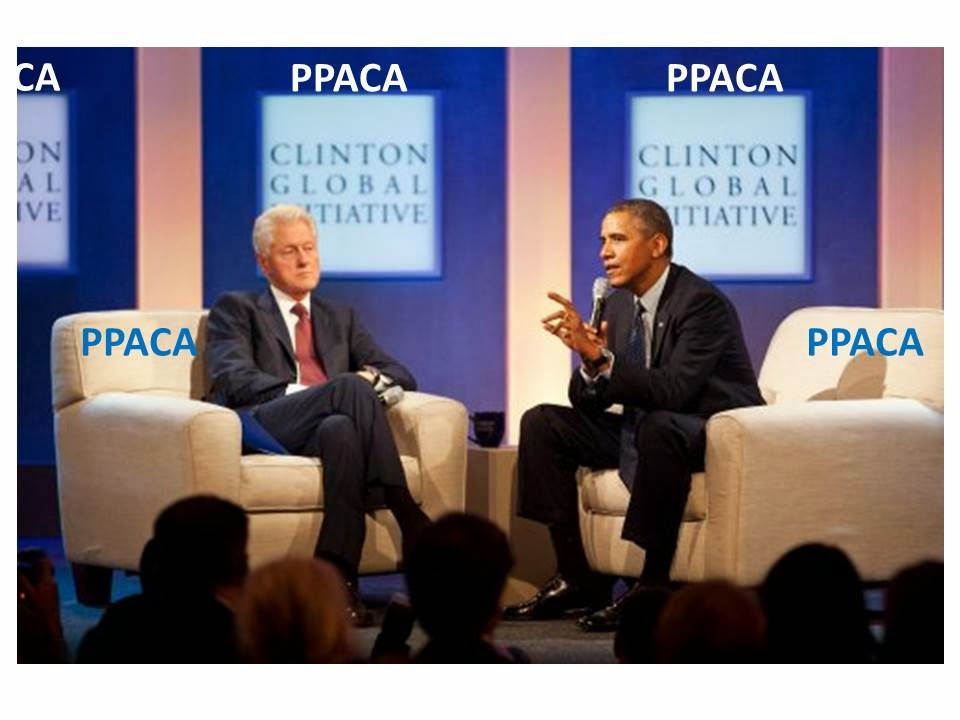
Obama Sells PPACA at CGI

The interchange between Presidents Clinton and Obama was sold this way by the White House (USA Today) :

The president and ex-president Clinton "will engage in a conversation about the benefits and future of health care reform in America and access to quality health care around the globe," said White House spokesman Jay Carney.
The Daily Beast commented on the surreal nature of our public stage:

Could the dialogue about the new health-care law get any more surreal? On one television network, Texas Republican Ted Cruz drones on and on about the evils of Obamacare, and on another, Democratic Presidents Obama and Clinton do their best to sell a skeptical American public on the new health-care law, sounding a bit like the Home Shopping Network as they put in a plug for people to go online to HealthCare.gov and sign up for coverage.
PPACA is surreal on other fronts.  Many corporate over-65 retiree health insurance plans are effectively going defined contribution when companies shift over-65 retirees from their employee group plans to individual Medicare Advantage plans through a private exchange.  This moves retired workers insurance from group plans to individual plans, the exact opposite of what Clinton and Obama stated in their interview.

Obama explained how pooling risk eliminates the expensive cost-shifting when emergency rooms provide care and pass the costs along. He also acknowledged raising taxes—gasp—on higher-income Medicare recipients and on so-called Cadillac plans, which has labor unions in a tizzy, and reducing the subsidies for Medicare Advantage plans.
If the feds are reducing subsidies for Medicare Advantage plans and employers cap their contribution, who does that leave to pick up future increases?  It's the over-65 retired worker.

Obama's statement about pooling risk eliminating expensive ER cost shifting is nonsense.  Pooling risk shares expensive ER costs across a larger group of people.  Benefit design and utilization controls eliminate expensive ER costs by making them the responsibility of the individual for any inappropriate use.

Health care coverage, employer and government provided, is marked by tremendous complexity.  The labyrinth of rules and procedures one must navigate to get coverage is the first hurdle.  The rabbit hole deepens when one needs to access emergency care, see a doctor or obtain a pharmaceutical.  Make a mistake and the penalty can be no coverage. 

Employers simply don’t like to be told they have to provide coverage, and people don’t like to be told they have to have coverage, he said.


Recently released Census data shows employers covering a smaller percentage of Americans.   If employers covered Americans as the same rate under President Clinton (1997), nearly 30 million of the currently uninsured would have coverage today. 

President Obama gave employers an extra year to meet any commitments.  He extended the date employers have to comply with PPACA to January 1, 2014.  The law allows employers to not provide coverage and pay a penalty.  The penalty is a fraction of the amount spent by employers offering a health insurance benefit to workers.

The simple act of dumping employer sponsored health insurance would be a financial boon to the C-Suite in executive incentive compensation.  This is the world we live in, where leaders, corporate and political, lie to people.

PPACA set up the acceleration of the great employer health insurance shedding, already well underway.  It also rejiggered the health care table for private equity underwriters (PEU's) to make billions buying and selling health care companies.  Think KKR and HCA, Cerberus and Caritas Christi Health System, Gentiva and Capstar's Harden Healthcare, CCMP Capital Partner's sale of CareMore to WellPoint.

Obama's White House Health Reformer had PEU origins and returned to her PEU roots after her public service.  Look for Nancy-Ann DeParle's Consonance Capital to lever PPACA to great profit.

Oddly, Nancy-Ann continued to receive private equity distributions from previously undeclared investments while serving in the Obama White House.  No conflicts here.  As P.T. Barnum would say "Move on the to Great Egress." 

Update 9-25-19:  PPACA Report Card:  Employers shifted costs to employees via higher deductibles and increased co-pays.   PPACA has not helped make healthcare more affordable.  It has made a lot of money for the PEU boys. 

Update 4-3-22:   The average health insurance premium more than tripled for a family plan since PPACA passed in 2010.  Cost curve bent but in the wrong direction.  Concave went convex.  

Wednesday, July 13, 2011

Hospital Deal Pricing: Cerberus, KKR and Cressey & Co.


Private equity underwriters (PEU's) are legendary for buying low and selling high.  That applies to hospital beds.  KKR's HCA plans to sell Palmyra Medical Center in Albany, Georgia to the large nonprofit system in town.  The price tag is $195 million in cash for Palmyra's 248 beds.

PEU Cerberus Capital Management got 1,552 bed Caritas Christi Health System for $895 million in capital commitments.  Conceivably, the hospital system can generate much of their multi-year capital through operations.

How do the deals compare on a per bed basis?

Cerberus purchase = $576,000 per bed

HCA sale = $786,000 per bed

The $210,000 per bed difference is indicative of America's bifurcated health care system.  Struggling safety net hospitals go for a lick and a promise to remain open, while majority PEU owned beds command a 36% premium. 

After buying Caritas Christi, Cerberus' new hospital division acquired two more Massachusetts hospitals from Essent Healthcare, an affiliate of PEU Cressey & Co.  The sale price was not disclosed.

One CEO highiighted the "instant access to capital" benefits of a Cerberus affiliation.  I take it that CEO didn't have ready access to Cressey's $50 million equity commitment to Essent.

Essent-Cressey and KKR-HCA share a Frist family tie.  Tommy Frist, Jr. and ex-Senate Majority Leader Bill Frist are part of the first family of for-profit health care. Cressey had this to say about Dr. Bill's role:

Senator William H. Frist, MD is a Partner and Chairman of the Executive Board responsible for acquisitions, divestitures and oversight of portfolio companies.

That means Bill knew about the deal.  HCA Tommy's Palmyra sale is held up by a Georgia Appeals Court.  It's set for an expedited hearing on September 19.

It seems HCA's buyout of the remainder of Denver's HealthOne may get oversight.  It's paying $1.45 billion for the 40% it doesn't own of the 2,259 bed system.  HealthOne beds are priced at a premium, $1.6 million per bed.  Of course, HCA can't buy cheap without harming the value of the 60% it already owns.

PEU hospital deals are America's present and future.  Beware hell hounds gnashing their teeth at the safety net door.  Once the hell hound opens the gate, struggling hospitals can be tempted by Satan's charms.

Update 10-15-23:   Steward settled with the Justice Department over False Claim Act violation (June 2022)

Sunday, June 19, 2011

Carlyle in Running for St. John of God's Pathology


St. John of God may follow Caritas Christe Health System in selling out to a private equity hell hound.  St. John's, an Australian hospital system, did not deny putting its pathology division on the blocks.  Bidders include The Carlyle Group's Healthscope.  Australian Business with WSJ reported:

"We estimate a price over $300m could still be about 2 per cent to 3 per cent earnings per share accretive for both Primary and Sonic (Healthscope competitors)," said Citi analyst Alex Smith.
The article mentions pathology's high fixed costs, which become higher after a sale due to additional interest, depreciation and amortization costs.  This move won't lower health care costs, but it may help Carlyle achieve targeted 30% annual returns.

St. John of  God was granted the vision of the infant Jesus.  His most famous miracle involved rescuing inmates from a fire in the Grand Hospital at Granada, with John passing through the flames unscathed.

Centuries ago saints walked through the fires of hell saving people.  Today, Wall Street bankers and private equity underwriters (PEU's) claim to do God's work. They walk unsinged through fires of raging health care costs, even as they add billions in interest expense, management fees and special dividends.  Neither the U.S. or Australian government minds for-profiteering in health care.  Their policies encourage its widening.

Safety net hospitals, I mean "tax exempt facilities," have a brutal three years until 2014.  That's PPACA's PEU pathology.  In the meantime For-Profiteers will do their part to drive up health care costs.  In contrast to St. John of God, help is not on the way.

Saturday, April 2, 2011

Scranton Sisters Sell Mercy


A judge cleared the way for Catholic Health Partners' sale of Mercy hospitals in Scranton, Nanticoke and Tunkhannock, Pennsylvania.  For-profit Community Health System (CHS) paid $150 million for the three hospitals and associated clinics, while promising to invest $68 million in capital improvements over a five year period. 

CHS didn't take all of Mercy Health Partners.  It left $214 million in Mercy liabilities with Catholic Health Partners.  It's not clear if these are pension agreements, retiree healthcare, professional contracts or professional liabilities.  I'm sure the judge and attorney general have the details.

The news provided details on the use of $68 million in capital

CHS Division President Martin Smith said he sees the need for renovations to Mercy Scranton's emergency room and updated equipment in the hospital's catheterization laboratory.
Emergency rooms are a high cost avenue for treatment.  Cardiac cath labs fit in the same category.  It doesn't bode well for health care costs decreasing anytime soon.  CHS had this to say at a Barclay's Capital conference in March:

ER Strategy: “The Front Door” of CHS’ Hospitals:

Initiatives
Renovations/Expansions – 54 projects completed, several currently under way
Marketing Programs - ER+
ProMed – Emergency room data tracking, quality management and measurement tool
Discharge call back implementation
Results
Improved patient satisfaction
Contributed to same store admission growth
CHS's total commitment of $218 million vs. CHP's $214 million Mercy liabilities makes this a fire sale. The deal echoes Cerberus Capital's acquisition of Caritas Christi Health System. 

Community Health System committed to keep Mercy's Catholic mission.  It's not clear if they have a buyout clause like hellhound Cerberus.

Company officials said the Catholic and charity care policies at Mercy will remain in place.  
What is Mercy's historical level of charity care?  CHS states they gave 3.7% in charity care in 2010.  Did they make any concrete commitments to serve Mercy's charitable mission?  Here's one hint they're backing away:

As part of the sale agreement, two new foundations will be formed to help people who can't afford the health care they need.
Mercy's CEO Kevin Cook provided details on the foundations while praising his new partner:

CEO Kevin Cook. “In CHS we found not only a financially strong and operationally experienced hospital system, but an organization that respects our Guiding Principles and shares our commitment to improve the health of the community.”

 As a result of the sale, approximately $25 million of charitable assets will be maintained in the area. Catholic Health Partners (CHP), the parent company of MHP, has committed to provide approximately $20 million (based on the projected price and after all liabilities are satisfied) between two local, non-profit foundations.

One foundation will be created and governed by local community members from the current Boards of MHP, Tyler Health System Foundation and Mercy Healthcare Foundation. The foundation will receive the $2 million donation from a subsidiary of CHS and will retain oversight for the existing $3.5 million in the Mercy Healthcare Foundation.

A second foundation will be created and governed by the Sisters of Mercy, Mid-Atlantic Community, the original sponsors of MHP, to focus on providing services that develop healthy communities and support the well-being of poor and under-served persons.
That doesn't exactly sound like paying for care needed by poor persons.  It's a shame CEO Kevin Cook won't stick around to clarify.

Look for more nonprofit community hospitals to sell out, a concern I voiced over a year ago. The prospect has CHS CEO Wayne Smith salivating:

"We continued to expand our portfolio of hospitals in 2010 with a very selective acquisition strategy. We believe there are a growing number of independent hospitals that fit our criteria and can benefit from having a proven operator manage their facilities. With the ongoing uncertainties in the economy, and especially with respect to healthcare regulation, we believe there are even greater opportunities ahead for Community Health Systems to make suitable acquisitions."
Suitable?  In the case of Mercy, it was a three piece suit, Scranton, Nanticoke and Tunkhannock.  It will soon be part of CHS, which stated in its last earnings release:

The Company's guidance does not take into account resolution of certain pending government investigations and lawsuits.

In such a case, it helps to own a chunk of Mercy.

Monday, November 15, 2010

Hell Hound Cerberus Gets Vatican & AG Blessing


Cerberus Capital Management acquired Caritas Christi Health System with the blessing of the Vatican, the Boston Archdiocese, and Massachusetts Attorney General Martha Coakley.  Coakley looked for conflicts of interest.  Here's what she found:

The Board and Senior Management appropriately disclosed and managed conflicts of interest that existed.  Members of the Board and Senior Management had no existing financial interests or business relationships with Cerberus.

The Steward Board has six of seven slots occupied by private equity underwriters (PEU's).  For-profit firms typically pay board members, some handsomely.  Board members often are required to hold equity in the firm.

PEU's entice senior management with future pay.  While they claim such pay is "performance based," the big payday comes when Cerberus flips Caritas Christi.  For senior management to participate, they must hold an equity stake.

Any incentive compensation granted to any members of the senior management team by Steward will be designed so as to reward individuals based on post-Closing  performance.
Surely the hell hound hinted to senior managers as to their future pot of gold?

The government of Massachusetts couldn't compel Cerberus to make clear their resources.

As Cerberus is privately held, its true size and the magnitude of its resources cannot be independently verified.

Cerberus pays an external auditing firm, does it not?  One might expect that kind of independent verification from a firm buying the largest nonprofit community hospital system in New England.

State and local governments expect to collect as much as "$100 million in taxes over the next four to five years."  The Attorney General's office received $1.5 million to conduct assessments on the impact of the acquisition over time. 

Caritas' pension plans have been frozen for some time.  While underfunded by as much as $225 million, they have assets.  The size was never stated in any documents.

Purchaser shall have significant input into the selection of asset managers for Pension Assets

Given Cerberus sells to pension funds, what can they do with a captive pension, one now insured by the feds?

PEU's are infamous for management fees and dividend bleeding.  Neither are prohibited under the agreement.

Sellers and Purchaser shall enter into a management services agreement in a form reasonably satisfactory to Purchaser.
It remains how much Cerberus charges for oversight.  It will take an S-1 to find out.  An IPO could come in three years.

There are many twists and turns to the Caritas-Ceberus deal.  Note:  Martha Coakley found Caritas Christi unsustainable, three years into Massachusetts health reform.  What does this say about stressed safety net hospitals, given Uncle Sam's help doesn't arrive in earnest until 2014?

America's health care future has a distinct PEU odor.  Uncle Sam, state governments, even the Vatican, don't mind the smell.

Update 1-26-24:  American Prospect summarized the damage Cerberus and Steward Healthcare did to Massachusetts hospitals.  Steward hired a restructuring advisor and may be headed to bankruptcy.

Update 3-8-24:  Axios did a story on Cerberus and Steward.  It accuses Cerberus of acting naively.  Haahaahaahaaa!  Once again the smartest guys in the room go stupid...

Tuesday, November 9, 2010

PEU's Stick HCA for Another Dividend Bleeding


KKR and Bain Capital will bleed HCA for another $2 billion in 2010.  This is on top of $2.25 billion paid out earlier this year.  Bloomberg reported debt will fund the latest dividend.

HCA, the largest U.S. hospital chain, said today it will sell $1.53 billion in high-yield debt to finance the payout to its private-equity owners.
Private equity underwriters (PEU's) don't call this bleeding.  That's too crass.  PEU's prefer monetization.  Owners expect to make three times their initial investment in HCA. 

Interest costs are included in hospital cost reports.  Over time, this will impact reimbursement from Medicare and Medicaid.  Patients and Uncle Sam will pay.

Health reform has PEU's dealing hospitals.  What's happening with HCA could be Caritas Christi in four years.  Will Cerberus have exercised Catholic identity buyout by then?


Update 11-14-10  Offering debt for dividends is PEU sleight of hand, given later IPO proceeds are marketed as "reducing debt."  This masks prior bleedings.  Take Carlyle Group's Booz Allen Hamilton.  Dividends, totaling $5.73 per share, gave Carlyle free shares.  They paid $5.40 per share to acquire BAH  The public will pay 3.3 times what Carlyle did in August 2008, $18 per share for 14 million shares.  Proceeds will be used to "pay down debt"  Is it the original debt or debt used to pay PEU's handsome dividends?

Update 5-24-11:  PEU's took a final vial of blood from HCA with a $181 million fee for terminating their management agreement.

Monday, October 4, 2010

Cerberus IPO Looms for Tower Automotive

Cerberus Capital Management is monetizing part of its investment in Tower Automotive (TA).  They plan to raise $122 million in an independent public offering.  Proceeds will be used to "pay down debt."

Private equity underwriter (PEU) Cerberus owns much of Tower's substantial debt, 86% of the $471 million first lien term loan and 100% of the $27.5 million letter of credit facility .   The S-1 states Cerberus purchased the debt in market transactions from other lenders, likely at a huge, tax-deferred discount.  What price will one head of Cerberus charge the other to retire the debt?  I smell a PEU profit maximizing transaction.

Other odors emanate from the Cerberus Tower.  TA's employment numbers were stated in their S-1: 

As of December 31, 2009, we had approximately 7,400 colleagues worldwide, of whom approximately 5,000 were covered under collective bargaining agreements.
Compare that to pre-Cerberus employment levels:

As of December 31, 2006, the Company had 10,477 colleagues worldwide, of whom approximately 5,800 are covered under collective bargaining agreements:
That's a loss of 3,000 jobs in three years.  Cerberus acquired Tower in 2007 for $1 billion.
In July 2007, the company completed the sale of substantially all of its assets to Tower Automotive, LLC, an affiliate of Cerberus Capital Management, L.P. and emerged from bankruptcy court protection as a leaner, strategically focused global company.

With new leadership, including president and CEO Mark Malcolm, the company deployed a wide range of initiatives and achieved major cost, quality and operating efficiency improvements across the business.

As a result of these process-driven initiatives, the company achieved $195 million in manufacturing and purchasing cost savings from Jan. 1, 2008 through Dec. 31, 2009.
The S-1 provides more detail on job losses:
2009 Actions 

In July 2009 in the International segment, the Company announced the closure of its press shop in Bergisch Gladbach, Germany. This closure impacted 57 colleagues, who ceased employment with the Company in October 2009. Total estimated costs of the closure of this facility are $10.2 million which is comprised of $9.1 million of severance costs and $1.1 million of other exit costs. The Company recorded the entire charge of $10.2 million during 2009 related to the closure of the Bergisch press shop. The additional charges incurred in 2009 in both the International and Americas segments relate to other severance costs, ongoing maintenance of facilities closed as a result of prior actions, and an additional impairment charge on an asset held for sale.

2008 Actions

In September 2008 in the Americas segment, the Company announced certain restructuring activities in its North American operations. The Company announced the closure of its Traverse City, Michigan facility. This closure impacted approximately 360 colleagues. The costs of the Traverse City, Michigan facility closure were recognized over the required service period of the colleagues through April 2009. Charges of $4 million and $4.5 million, respectively, were recognized during the years ended December 31, 2009 and 2008 for a cumulative charge of $8.5 million. The charges incurred during 2009 were comprised of $0.1 million of severance costs, $1.8 million for an additional impairment charge on the facility, and $2.1 million of other exit costs. The charges incurred during 2008 were comprised of $4.4 million of severance costs and $0.1 million of other exit costs.

2007 Actions

During 2007 in the Americas segment, the Company announced the closure of certain facilities in its North American operations in an effort to realign capacity with demand during bankruptcy. The Company closed its Kendallville, Milan, Granite City, and Upper Sandusky facilities and incurred restructuring and asset impairment charges of $20.9 million relating to these closures. 
The 2007 restructuring must have been a bloodbath.  While in bankruptcy, Tower cut retiree medical care, shifting responsibility to VEBA's.  Cerberus assumed ownership on July 31, 2007.  How many layoffs occurred under their tenure vs. bankruptcy court?

Will the Brookings Institute study private equity's impact on employment?  Will Caritas Christi Health System look at Cerberus Capital's track record in other industries?

How many Tower related VEBA's are in health reform's $5 billion retiree medical plan giveaway?  Hell hound's love free money, especially when it comes indirectly through union agreements.

Two lists continue growing, PEU "cash ins" and ERRP recipients.  Political and corporate big boys throw billions to one another.  So what if they step on a few thousand people along the way.  Rest assured, Cerberus is on multiple tracks to profit from Tower.

Cerberus Capital's Catholic Option


Hell hound Cerberus Capital Management entered into a deal to buy Caritas Christi Health System, the largest nonprofit community hospital system in New England.  The deal includes an option to drop the system's Catholic nature in return for $25 million.

Caritas Christi was established in 1985, yet the Catholic identity of individual hospitals goes back to 1863.

Carney Hospital 1863--147 years
St. Elizabeth's 1888--122 years
Good Samaritan 1902--108 years
St. Anne's Hospital 1906--104 years
Holy Family Hospital 1950--60 years
Norwood Hospital 1997--13 years


As for the Caritas Christi Health System, their website states:

Our Mission is our reason for being:

Caritas Christi Health Care, rooted in the healing ministry of Jesus, is committed to serving the physical and spiritual needs of our community by delivering the highest quality care with compassion and respect.

Jesus has been optioned.  The $25 million "Christ buyout" equates to $45,000 per year of Catholic affiliation (554 years among the six hospitals).  Will the hell hound go against its nature?

Update 1-26-24:  American Prospect summarized the damage Cerberus and Steward Healthcare did to Massachusetts hospitals.  Steward hired a restructuring advisor and may be headed to bankruptcy.

Update 3-7-24:  Now that the PEU boys have stripped Steward Health of vital resources, it's carcass has a recovery plan.  The state of Massachusetts has had enough of Steward's mismanagement. 

Update 3-8-24:  Axios did a story on Cerberus and Steward.  It accuses Cerberus of acting naively.  Haahaahaahaaa!  Once again the smartest guys in the room go stupid...

Update 6-16-24:  "Cerberus pocketed $782 million for itself and its investors from its ownership of Steward."

Monday, April 19, 2010

PPACA Passes & PEU Hospital Deals Take Off


Before President Obama could sign health reform, two major safety net hospital systems sold out to private equity underwriters (PEU's). Here are the deals:


Detroit Medical Center and its eight hospitals agreed to sell to The Blackstone Group's Vanguard Health Systems.

Boston's Caritas Christi and its six nonprofit community hospitals will sell to Cerberus Capital Management.

CCMP Capital's Legacy Hospital Partners inked a joint venture deal regarding 215-bed Wilson N. Jones Medical Center, Sherman, Texas. The hospital will be renamed.


In each arrangement, all committed capital will be invested in the asset purchased and/or used to retire tax free bonds. This departs from past deals, which put millions into community foundations.

Vanguard paid Blackstone, Morgan Stanley Capital Partners and other owners a $300 million dividend earlier this year. That's 100% of Vanguard's EBITDA, otherwise known a parental milking. PEU owned HCA borrowed to give $1.75 in dividends to KKR and investors.

My worries about nonprofit community hospitals came just before the spate of sellouts. When barbarians crash the gate, they do so in force. I knew Nancy-Ann DeParle's reform would set the table for deals. I didn't realize how quickly they'd arrive. Prior to becoming White House health czar DeParle worked for CCMP Capital Advisers and sat on the Legacy Hospital Partners board.

The shadow banking boys plan to bleed America's health care system.

Update: Sumner Regional Health System took bids from suitors, before entering bankruptcy. After shedding undesirable costs/contracts in bankruptcy court, for-profit LifePoint Hospitals will take over Sumner's four hospitals. The FTC provided an antitrust exemption for the deal.

Update 2: HCA will acquire 357 bed Mercy Hospital in Miami from Catholic Health East.

Update 3-12-11:  Forbes ran a piece on how HCA will save America's healthcare system   Like HCA's March 2011 IPO, other PEU owned hospital chains may go public, according to Fortune.

Update 5-24-11:  HCA closed on Mercy Hospital.  Terms of the deal were not disclosed.

Update 8-20-12:  Dealbook reported investors in health care support Obama.  That's no surprise.

Update 12-10-12:  BusinessInsider ran a piece on growing pressures driving hospital consolidation.

Update 2-24-14:  PEU's buying hospitals is the first niche area mentioned by Becker Hospital Review. 

Update 4-3-22:   The average health insurance premium more than tripled for a family plan since PPACA passed in 2010.  Cost curve bent but in the wrong direction.  Concave went convex.