Sunday, December 11, 2011

PEU Ships to Come In?

FT reported:

When Wilbur Ross, one of the world’s leading distressed asset investors, announced his first shipping investment on August 1, reactions within the shipping industry were mixed. Some welcomed Mr Ross’s investment as a sign that the steady recent trickle of private equity investment into the industry might turn into a flood of fresh capital.

Wilbur Ross and The Carlyle Group specialize in distressed asset turnarounds, some with lethal consequences.  Carlyle recently executed a Chinese ships deal, after one Chinese affiliate had its stock trading suspended.

FT went on to say:

Some shipping industry figures say private equity return expectations are simply unrealistic.

Note: Private equity underwriters (PEUs) are the answer to America's ills in healthcare, infrastructure and education.  How much Montana water would it take to float a Carlyle Chinese ship?

CEO Severance Packages Worsen Peformance


CEO Golden Parachutes, multimillion dollar severance packages, are associated with poorer corporate performance, according to a Tulane University study.  Chief Executive.net reported:

After putting a severance agreement in place, on average, companies underperformed the markets by 1.6 percent.  And companies whose agreement was cash-only underperformed the markets by 4 percent.

56 percent of S&P 500 companies offer severance packages.
Over half with severance packages is interesting in light of CEOs populating one another's board of directors.  Tulane Finance Professor Peggy Huang conducted the study after seeing a 175% rise in the use of CEO severance packages

1993 - 20% of firms offered golden parachutes
2007 - 55%gave severance packages

Professor Huang suggested switching from cash severance to packages with stock and options substantially represented.  Huang believes this aligns the CEO with the interests of the firm.  Following her research, that would move a firm from 4% to 1.6% under performance. 

There is another problem with her recommendation.  Did Huang forget the CEO stock option backdating scandal which ran from the early "90's to to 2004?  CEOs cheated on a widespread basis, as 29.2% of 7,774 companies engaged in
"timing manipulation" for executive stock option grants.  

CEO pay exploded in 2007.   CEO pay in 2010 rose mightily for most chief executives rom 2009. The WSJ conducts an annual study of CEO compensation, with the latest covering 2010.

Consider my CEO compensation comment from September 2007:

Free markets have American businessmen, who fund U.S. politicians, all pursuing the lowest common denominator (on worker pay/benefits), with the main exceptions CEO pay and investment manager's (PEU) compensation.

This was a six months before Carlyle Capital Corporation defaulted and a year prior to Lehman Brothers implosion.  Since then American branded banksters got their compensation back on track.  CEO severance pay evolved into the platinum kiss when packages rose to over $100 million.  The meanness and greed club looks after itself.

Update 12-15-11:  CEO pay soared in 2010.

Update 12-26-11:  Benefit cuts since 2007

Saturday, December 10, 2011

UK's Circle Holdings: Hedge Fund Healthcare


Reuters reported a month ago:

CIRCLE HOLDINGS PLC (CIRC.LN), a U.K. hospital operator, said it has finalized a contract that will make it the first private company to take over the running of a National Health Service hospital, in a deal that will see Circle manage GBP1 billion in revenue over the contract's 10-year life.

Circle Health was selected as preferred partner to run Hinchingbrooke Health Care NHS Trust in November 2010. The company said it has now signed a definitive contract to deliver a full range of services at the hospital, located near Cambridge, starting in February next year.
The Guardian reported six investors control 95% of Circle Holdings, run by Ali Parsa, a former Goldman Sachs banker.  What's interesting is Parsa got the UK's Competition Committee to take up his issue of small private's being shut out.

Bloomberg reported:

Circle Holdings Ltd., a London- based private-hospital operating partnership, said today that it filed an antitrust complaint in September 2010 regarding ties between private providers and insurers that prompted the OFT’s study.


“Today’s decision will have a profound effect on U.K. health care, unleashing entrepreneurialism and unlocking innovation,” Circle CEO Ali Parsa said in the statement.


Private equity underwriters, like The Carlyle Group's David Rubenstein, salivate over health care.  Carlyle closed on PPD, the clinical drug trial company, and is bidding on Rottapharm, an Italian pharmaceutical maker.

PEUs won't decrease the cost of health care, not with added management fees, higher interest expense, dividend bleeds and targeted 30% annual returns on investment.  I find it interesting that they're the answer to global healthcare ills.  It seems they are at least one form of disease.

Mountain Water Soon to Be Carlyle's


The Carlyle Group's Robert Dove is about to land his first water infrastructure project.  The Montana Public Services Commission issued a draft order recommending approval of Carlyle's purchase of Park Water, which owns Missoula's Mountain Water.

The California Public Utilities Commission gave its approval last week.  Park is based in California and will be acquired by Carlyle's Western Water LLC.

Mountain Water Draft Final Order

Montana's PUC will vote on Tuesday.  The draft order makes reference to numerous stipulations, which can be found below:

Newpsc Doc (3)

From my reading Carlyle can still charge management fees to Mountain, tap the company for dividends and special distributions, and float debt. Carlyle expects 20% annual returns in the public infrastructure arena, down from its normal 30% annual ROI.

Mountain may have doubled in price when The Carlyle Group is ready to monetize its investment. It's nice Carlyle has a ready buyer in Missoula city government. I predict Mountain will be unaffordable by then.

Friday, December 9, 2011

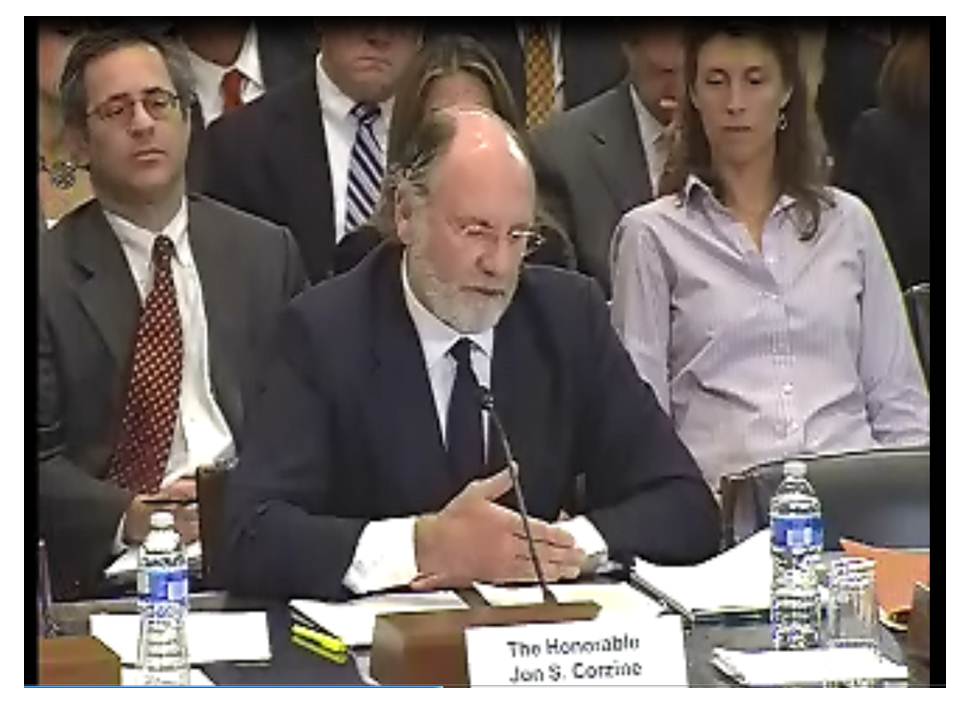
Corzine Avoids Cause of MF Global Failure: Bank Run


MF Global CEO Jon Corzine slimed his way through testifying before the House Agriculture Committee.  Jon didn't know what was going on as the firm slipped from "meticulous record keeping" on customer accounts to "chaos over a two to three day period."  Oddly, Corzine said the firm was in due diligence over the prospect of selling MF Global.

A panic sale can occur when the firm's tangible assets aren't close to clients' investments and is deep underwater.  Not many buyers will take on risk they can't understand, even at fire sale prices. 

What would they have bought?  Corzine pushed MF Global to invest in repo's, of which he stated in his written testimony:

MF Global was required to recognize its profit immediately in RTMs, and the asset (the debt security) and the liability (the money owed to the Counterparty) must be “derecognized,” i.e., removed from MF Global’s balance sheet.

It sounds like Enron fiction, immediate income statement profit with off balance sheet liability.  Corzine's MF Global might as well be Greece, with its Goldman Sachs repo.

During the last hours, last days, Corzine stated there were "many, many, many more transactions than typically occur."   Customers wanted their money.  The lucky ones were at the head of the line.  It's called a bank run.


Levered up 30 to 1, it didn't take much of an equity hit, combined with imploding sovereign asset values to put MF Global into the grave.  Corzine played personal risk manager for much of his testimony.  After 19 months as CEO of MF Global, the firm no longer exists.  The buck stops nowhere for Jon Corzine.


Be sure to check out the video.   It shows how far the leadership ball has fallen.

Update 12-10-11:  Lehman used repos, which hid its imploding financial position.  MF Global shows it can happen again.

Update 7-17-19:  The SEC blessed Corzine's new levered $600 million hedge fund.

Update 8-3-19:   “Why on earth should the SEC allow him to have a license to handle customer money once again?”  Couldn't have said it better.  Corzine is back!

Thursday, December 8, 2011

Corzine & Sarkozy: Neither About Transparency

MF Global's Jon Corzine pretended to be honest and accountable in testifying before Congress on his firm's thievery of customer money.  Like BP's Lord John Browne and Tony Hayward, Corzine implied incompetent underlings caused the disaster.  Dealbook reported:

"In theory, an employee may have misused customer cash after misinterpreting the chief executive’s words."
So one employee pulled $1 billion of customer assets into MF Global's trading money?  That defense is patently laughable.  Jon Corzine testified before Congress to manage his personal risk. The insider suck up included:

One congressman even congratulated the former Goldman executive on achieving considerable wealth.
Corzine's acts caused market dislocation.  Olivier Sarkozy, another insider with The Carlyle Group, offered his assessment as to how private equity underwriters can help in turbulent times:

It is very hard for traditional (debt) issuers to provide enough clarity to the public market investor to allow that investor to make an informed, risk-adjusted decision. The assets are simply too large and the leverage too great to allow those markets to operate efficiently in times of dislocation.
 Olivier says PEUs are the answer:

"That is where private equity can step in and provide that transparency because we can underwrite these balance sheets. It takes a lot of time and effort, but it is possible to do. In that context we become the most efficient source of capital to the industry and that is where the opportunity lies," he said.
Carlyle and company took $2.3 billion in FDIC cash to recapitalize BankUnited. 

BankUnited was floated in February this year and Carlyle made 2.7 times its money on its investment.

Carlyle wasn't transparent.  It wasn't until BankUnited's public offering when Carlyle revealed the extent of FDIC funding in BankUnited's recapitalization.  Carlyle held BankUnited a year before filing for an IPO.

Congress provided a stage for Jon Corzine to offer his bunk and happily ignored the huge public subsidy for PEUs via BankUnited.  The Carlyle Group's IPO revealed the firm to be a virtual nonprofit, given its incredibly low tax burden (a highly symbolic 1%). It's a PEU world for elected and greedy business people.

Tuesday, December 6, 2011

Carlyle's 2011 IPO Falls into 2012?


The Carlyle Group's planned independent public offering (IPO) will leak into 2012.  CNBC reported:

According to data-provider Dealogic, 79 of 119 this year’s IPOs, or 66 percent, are currently underwater.

Carlyle monetized numerous affiliates in 2011, before debt and IPO markets began to freeze.  As expected private equity had another banner year, according to Efinancial News:

In the year ending June 30, developed markets funds returned 36.9%, compared with 29.9% returned by emerging markets funds.
Add Carlyle's nearly tax free status and the PEU boys had a very good first half of the year.  The second half looks tepid, given Carlyle's assets under management fell from over $153 billion to $148 billion.  I take it some people chose not to reinvest or mark to market valuations bit into Carlyle's AUM.  Carlyle's next S-1/A might shed light on the situation.  Then again, it may not.

Update 12-7-11:  Investors may wish to check out the state of PEU frenzy deals closed between 2006 and 2008