Wednesday, October 15, 2014

CDC Worries: Carlyle Axes North Africa-Middle East Fund


(Persian) Gulf News reported:

Carlyle has shelved plans to market a second private equity fund targeting the Middle East and North Africa.

CDC Chief Tom Frieden said just days ago:

“I’ve spoken with business leaders who’ve emphasized to me that there’s so many misconceptions about Ebola that they’re already seeing things like a reduction in investment in parts of Africa that are not in any way, shape or form involved in the Ebola outbreak.” 
Timing of the cancellation is interesting in light of Carlyle's returns on its first Middle East North Africa fund.

Carlyle’s first $500m (Dh1.8 billion) private equity fund for the region was raised in 2007 and ran out of money earlier this year. It was generating a 35 per cent cumulative gain as of September, before fees, according to investors.
Carlyle's logic in targeting the region is:
 
We believe the MENA region is large, growing rapidly and ripe for private equity investing:
  • Economy has world’s fifth largest GDP (growth projections through 2010 are 55% higher than rest of the world and 76% greater than the U.S.)
  • Population is world’s third largest at 426 million
  • Capital markets are maturing and large enough to provide exit opportunities
  • Liberalizing state agendas creating opportunities for large scale transactions (increasing large scale privatizations)
  • Low private equity penetration
  • Carlyle’s regional presence provides opportunity for cross-country investments and M&A within the MENA region
Carlye stubbed its toe with the bankruptcy of Carlyle Capital Corporation.  Kuwaiti investors sued Carlyle for selling the highly leveraged mortgage backed security fund as virtually risk free.  That case is yet to be heard.  

It interesting the timing between Frieden's Ebola investment concern and Carlyle's cancellation.  Was there a White House intermediary?

Sunday, October 12, 2014

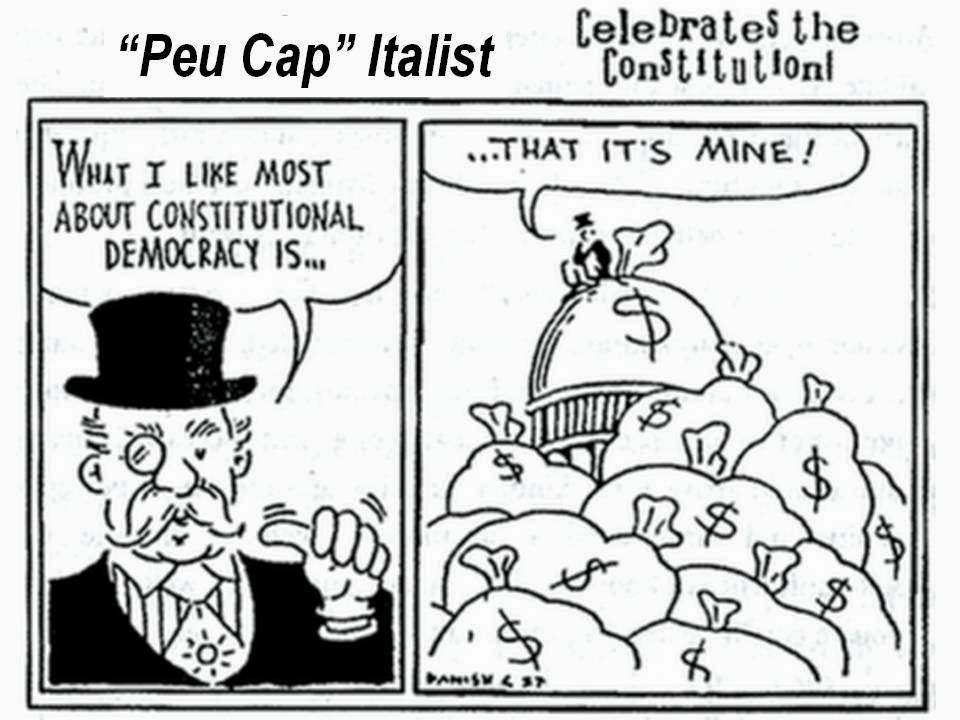
Political Campaign Donors of PEU Variety


CNBC reported the impact of shadow bankers on this years political elections.

A small group of ultra-wealthy private fund managers are dominating political spending this cycle, making up for declining involvement from banking executives. 

Private equity professionals also are giving in record amounts for the midterms, which historically attract far less cash than presidential election years. PE pros have donated $28.8 million this election cycle, up from $20.5 million in 2010, according to CRP. Like hedge funds, the industry gave equally to both parties in 2010 but now favors the GOP nearly 2 to 1. Top PE firm donors include J.W. Childs, Blackstone Group, BLS Investments, Bain Capital and Carlyle Group.

The rise of PE and hedge fund spending comes as bankers slow down.
PEU wankers replace banksters and this is somehow comforting?

It all adds up to a record for the financial community. "Wall Street has ramped up its giving this cycle, delivering more than $120 million and already exceeding what they spent throughout the entire last midterm."
I sense another free pass for preferred carried interest taxation.  That should be safe and sound for the sixth or seventh time. 

Saturday, October 11, 2014

CalPERS Targets PEU Big Three


Pensions & Investments reported:

CalPERS' investment committee has cleared the way for the pension fund's private equity staff to make more investments with its three largest private equity partners, Apollo Global Management, Carlyle Group and Blackstone Group, allowing billions of dollars more to go to the private equity giants.

The committee approved raising the limit on the amount of committed capital that can go to any one private equity firm to 15% from 10% of the pension fund's $31.4 billion private equity portfolio.
CalPERS invested in 7 Blackstone funds, 10 Apollo funds and 27 Carlyle funds.  Storied PEU's will garner more of CalPERS private equity investments.

While the disclosure does not name the managers, CalPERS statistics show that as of March 31, Blackstone was near the 10% cap with more than $2.5 billion in investments; Carlyle, with more than $3.5 billion, and Apollo, with more than $4.5 billion, exceeded 10%.

The move enables CalPERS to put another $2 billion in Blackstone and $1 billion in Carlyle, in which CalPERS once held an equity stake.   Ring the bell on Pennsylvania Avenue!

Friday, October 10, 2014

Carlyle Siphons Park Water for $5 million in Dividends


The Missoulian reported:

In April, Class A holders – meaning the parent company, The Carlyle Group – received a dividend of $2.5 million from Park Water Co., according to the document. Another $2.5 million dividend is scheduled to go to Carlyle on Dec. 31 of this year.

Carlyle's multiple layer of chiefs will benefit from more than a series of final dividend bleedings.

“It is not uncommon for executives and senior employees in a limited liability company to receive profits interests or other equity interests designed to incent and align the management team with the owners to help increase the company’s value,” he explained. “Profits interests are akin to stock options in a corporation.” 
 Ah, stock options which proved how executives will cheat on a widespread basis to garner prizes.  Executives backdated nearly 30% of stock options to maximize their take home pay.  Optimizing executive pay actually decreased their company's value.  Those who forget the lessons of the past are doomed to repeat them.

Now who swung for the fences, packaging junk as investment gold?  This caused the fall 2008 financial meltdown.  Don't forget that Carlyle's Blue Wave Partners hedge fund and Carlyle Capital Corporation were two canaries in the financial coal mine.  Both imploded earlier in 2008.

Carlyle has been monetizing assets left and right recently.  It helps to have a cash cushion should another downturn arrive.  Missoula residents have done their part to enrich Carlyle.

Carlyle is ready to leave public infrastructure, like Park Water.  It aims to profit from energy infrastructure.  Carlyle cofounder David Rubenstein was coy with board members from the Alaskan Permanent Fund when asked about investing in energy infrastructure.  The story ran in Mrs. Rubenstein's Alaskan newspaper.

At a recent meeting of the Board of Trustees, outside investment adviser George Zinn questioned David Rubenstein, managing director of one of those private equity funds, The Carlyle Group, about the wisdom of investing in the Alaska natural gas pipeline.

The billionaire financier warned of the risks of  investing state money so close to home and said the politics of Alaska are even more complicated than those of Washington, D.C.

"I just don't know whether the economic upside is worth the political risk," Rubenstein said, but he cautioned that he wasn't familiar with the project's merits.


So why would he discourage the board from investing in a project when he is unaware of its merits?  Look for the Permanent Fund to partner with Carlyle on energy infrastructure.  Rubenstein is the consummate salesman.

I can hear the talk at 1001 Pennsylvania Avenue.  "Ready to cash in on Missoula water?"  Check.  "Line up the PEU sights for global energy infrastructure."  Sir, yes sir!  "PEU profit steam ahead!"

Thursday, October 9, 2014

CDC Concerned About African Investment


Dr. Tom Frieden of the Centers for Disease Control threw a nod to private equity underwriters (PEU's) targeting Africa when he expressed concern over cancelled investments.

“I’ve spoken with business leaders who’ve emphasized to me that there’s so many misconceptions about Ebola that they’re already seeing things like a reduction in investment in parts of Africa that are not in any way, shape or form involved in the Ebola outbreak.”

I found interesting his dodge on the question about care delays for the Dallas patient, also referred to as the Index patient.  Frieden said he could not comment on any individual patient.  The CDC is charged with evaluating every aspect of care for an index patient, as it could impact care down the line for later patients.  That includes their care in the emergency room or days later in the hospital.

As for Texas public health system it has been gutted the last fifteen years. It dropped access to primary care in the new millennium.  Our local health department shed its pediatric clinic, AIDS clinic, and social services.  It drastically reduced immunizations and sexually transmitted disease testing and treatment, which are the only services left.  If our community was overwhelmed by a syphilis outbreak, I shudder to think what would happen with a deadly virus spread in airborne fashion. 

Investment in West Texas is strong due to the oil boom.  So we don't have Africa's worries, unless imported workers are building new hotels, apartment complexes or working in the oil field.  Then we might share the same worries. 

PEU's should not worry about their planned African investments. Dr. Frieden said everything is going to be alright.

Update 10-12-14:  A Texas hospital worker contracted Ebola from the Index patient. The news report states:  There was no word yet how the health worker was infected, but the director of the Centers for Disease Control and Prevention (CDC) said it indicated a professional lapse that may have caused other health workers at the hospital to be infected as well.  "We don't know what occurred in the care of the index patient, the original patient, in Dallas, but at some point there was a breach in protocol, and that breach in protocol resulted in this infection," CDC director Dr. Thomas Frieden told a news conference.
Hospital officials said the worker had been wearing CDC-recommended protective gear during treatment, including gowns, gloves, masks and shields.  "We are evaluating other potential healthcare worker exposures because if this individual was exposed, which they were, it is possible that other individuals were exposed," Frieden said.

Update 10-15-14:  A second Texas hospital worker has Ebola.  Texas' depleted public health system combined with CDC incompetency (staff told the infected patient she could fly with a low grade fever) gives a Keystone Cops or Three Stooges impression to the general public.   Financial markets fell substantially, in part to the new Ebola case. 

Update 10-17-14:   The CDC's Keystone Cops routine continues.

Sunday, October 5, 2014

PEU Tank Cars


Toss a rock in any direction in today's economy and you're likely to hit a private equity underwriter (PEU).  That includes train cars.  .

Railway Age reported:


The railcar market continues to follow a trend of outrageous demand in some car types mixed with tepid demand in others. With a current backlog (as of the end of 1Q2014) of almost 82,000 cars, demand is strong for covered hoppers and tank cars with light to no building of other car types.  There are new operating lessors funded by a variety of monetary sources, private equity firms, and bank leasing companies—all competing for the same transactions in the marketplace.

All in all, the leasing marketplace for rail equipment is volatile, aggressive, and hungry.

Reuters reported:

Axeon Specialty Products, which leases about 1,200 tank cars to transport heavy crude south from Canada to East Coast asphalt plants, said it does use some AAR 211W tank cars, but it was as yet unclear how much it would be impacted.

"Some of them are the AAR cars and that is why we are working with the cars owners to determine what we can and cannot do," said Axeon spokeswoman Claire Riggs. She was unable to say how many AAR 211 cars the company leased.

Axeon, owned by New York private equity firm Lindsay Goldberg, was until this week known as NuStar Asphalt.
PEU money is behind a new crude-by-rail facility proposed for Colorado’s booming Niobrara field.

It costs $1,300 a month to lease a tank car, which requires only $20 a month in maintenance.  That car can hold between $1.5 and $3 million in oil.  A tank car ordered today will roll off the line in summer 2016.  There are 77,000 new tank cars produced a year.

Limited supply, huge operating margins, and massive demand from the oilfield as far as the eye can see.  This is a PEU's dream.  

Part of U.S. Commerce Secretary Penny Pritzker's massive fortune came from Union Tank Car.  She omitted a portion of it in her $80 million error in her federal financial disclosure.  

The Carlyle Group revealed it would shed public infrastructure in favor of the energy kind:  WaPo reported:

Carlyle is exiting business of bridges, water and highway stops after eight years. It’s going into energy infrastructure instead.

One has to wonder how multiple layers of massive profits works it way through to the price consumers ultimately pay.   Not to worry as long as the greed and leverage boys (and girls) get their grand returns.  Old McDonald had a farm, PEEEU.

Wednesday, October 1, 2014

Presidents & PEU's


The Carlyle Groups of the world formed in the 1980's but grew exponentially during the Bush and Obama years.  Clinton privatized government functions that have since been flipped multiple times by private equity underwriters (PEU's). 

PEU's are ubiquitous and interwoven with both Red and Blue political parties.  Government feeds them in multiple ways, preferred taxation, direct contracts with PEU affiliates (security, defense, health care, education, infrastructure, etc.), earmarks,

Many employees of PEU affiliates found their jobs eliminated and pensions frozen.  The picture above shows what happened to their wages.  It's no wonder consumer debt recently hit a new record $3.2 trillion.

Presidents like to take credit for anything good happening in the economy.  I believe all three deserve credit for enriching their peers, the greed and leverage boys.

It's a sick system, a disturbing cycle that repeats under a President who promised to take on these very interests.  Take them on he did, as full and present partners in his administration.  The other two worked for PEU's, Bush II for The Carlyle Group as a board member of CaterAir and Clinton for Yucaipa and Teneo.

"The Clinton, Bush and Obama administrations all could have prevented the financial meltdown...We have created the incentive structures that are going to produce a much larger disaster.”--William K. Black 

The picture is at the top of this post.  Both the quote and the graph came from JessesCafeAmericain.

It's a PEU world, where politicians Red and Blue love PEU...

Update 10-4-14:  The fact that the majority of households are losing so much wealth in a time of record-breaking overall wealth demonstrates how systemically corrupt the economy has become.  Washington's Blog