Monday, July 22, 2019

Philadelphia Energy Solutions Bankrupt Again: Carlyle Minority Owner


The Carlyle Group's connection to Philadelphia Energy Solutions flamed out with the company's second bankruptcy filing in two years.  Flashback to September 2012 when the private equity underwriter (PEU) announced the deal:

Philadelphia Energy Solutions (PES), the longest continuously operating refinery in the U.S., today officially launched its partnership with The Carlyle Group (NASDAQ: CG) and Sunoco Inc. (NYSE: SUN) at a celebration attended by elected officials, labor and business leaders, and hundreds of refinery employees. Philadelphia Energy Solutions also unveiled a new video depicting the determined efforts by business, labor and government to keep the refinery open for business.
Public support reached $25 million in grants.  A Carlyle press release cited state dollars:

Philadelphia Energy Solutions, with economic support from The Commonwealth of Pennsylvania, will invest in several capital intensive projects that are critical to the long-term economic viability of the facility. Planned improvements will help the environment through reduced waste and emission, and reduce reliance on foreign oil supplies. The Commonwealth will provide grants to help build a high-speed train unloading facility at the refinery, support a major capital project and upgrade the Cat Cracker (FCCU) at the refinery.
Nearly seven years and one bankruptcy later Philadelphia Energy Solutions literally blew up.


Carlyle had plenty of dry powder to save Philadelphia Energy Solutions but the greed and leverage boys refuse to throw good money after bad.


Here's a picture of the nearly $600 million in good money Carlyle siphoned from PES before its initial fall:


Another interesting fact had the PES executive in charge of derivative trading leave the firm in March.  Carlyle had Semgroup blow up from $2.4 billion in bad energy bets via forward looking contracts.  I am not saying bad derivative bets contributed to PES second bankruptcy but found the timing interesting.

Pennsylvania's Governor is taking a Carlyle like approach in not throwing good money after bad.  Carlyle won't refund public dollars for failure to meet an affiliate's commitment.  Texas learned that with Vought Aircraft Industries.  Governor Rick Perry's office gave Carlyle $35 million for 3,000 new jobs.  As the six year deadline approached Vought had cut 35 jobs, $1 million per job eliminated.

Workers are nervous about their future.  Reuters reported:

The company began selling the refinery’s oil supplies and equipment announcing it would seek to permanently shut the plant, sources have told Reuters.  The asset sell-off triggered worries among workers that the company no longer aimed to find a buyer willing to restart the plant, as it had said it would do.  The sale proposals included offers for future crude cargoes and time-chartered Jones Act vessels, sources had told Reuters. 

More than 600 union refinery workers will be laid off on August 25. Others were let go shortly after the fire. Hundreds of contractors that do business with the refinery are also expected to be affected by the shutdown. 
Owners Credit Suisse and investment firm Bardin Hill and PES debtholders seek to recover $1.25 billion in insurance losses from the June explosion.  The Chemical Safety Board is investigating the blast and is yet to issue a report with their findings.

Most stories on PES second bankruptcy have omitted Carlyle's ownership, albeit now minority.  That echoes the Bush White House which omitted 25 patient deaths from Carlyle owned LifeCare Hospitals from its Hurricane Katrina "Lessons Learned" report.  Like PES, LifeCare declared bankruptcy after seven years of PEU ownership (as did nursing home giant ManorCare after ten years of Carlyle sponsorship).

Some deals sink.  Others blow up but Carlyle's billions in dry powder won't be used to pay back economic development agreements or retain promised jobs.  The PEU boys take their money and run.

Update 7-28-19:  The Obama White House helped setup the deal.  The Trump administration helped the PEU boys avoid responsibility after bankruptcy number 1 and may help again with bankruptcy part deux.

Update 8-19-19:  Bankruptcy trustee objected to Kirkland Ellis serving as bankruptcy counsel for PES due to its representation of PES creditors, Credit Suisse, Carlyle Group and Bardin Hill

Sunday, July 21, 2019

Carlyle Back in Public Water via JV


The Carlyle Group announced a joint venture with VICO Infrastructure  to invest in public water projects.  The announcement comes after Carlyle's contentious ownership of Mountain Water in Missoula, Montana.  Carlyle pulled $2 million in overhead/annual management fees from Mountain Water before reneging on its promise to sell the water utility to the City of Missoula.  Carlyle sucked $15 million from Mountain Water, $10 million in management fees/overhead and $5 million in dividends. 

Carlyle's co-head of its Global Infrastructure Opporunity Fund said of the VICO JV.  WaterWorld reported:

“Population growth and increased economic activity in areas with limited water supply are increasing constraints on water infrastructure. We see a significant opportunity for VICO and Carlyle to invest in these communities to deliver improved, sustainable and resilient infrastructure for all stakeholders.”

Carlyle and VICO will invest in revenue producing projects that will hit citizens directly in their pocketbooks.  Carlyle co-founder David Rubenstein expects 20% annual ROE on infrastructure projects.  It launched a $2.5 billion Global Insfrasture fund in 2016.

WaPo said Carlyle had grown tired of water projects and would focus on energy instead.   That was 2014.  Apparently a few hot summers increased Carlyle's thirst for return.  Thus, public water is back on the PEU table.

Carlyle's partner is headed by the former President of PERC Water Corporation.  PERC completed water projects mostly in California and Arizona.  In Montecito, California wealthy citizens desired more water and mobilized candidates to achieve their objective.   The Water Board refused to hear a proposal from PERC in 2014.  Four years later a Trump like campaign sought to replace the board en masse.

PEU ownership, which is now widespread in healthcare, will not make water more affordable.  Surprise medical bills could soon be followed by surprise water bills.  How high can household debt go for the non-rich?

Update 1-23-24:  People in Pennsylvania are learning what it is like to be "Mountain Watered," i.e. have your local water utility sold to a private equity owned affiliate.  One Pennsylvania town had a deal for its sewer system but that turned into "Harbor Island," when the firm shifted to renewable energy and away from public water/sewer systems.

Saturday, July 20, 2019

Blue Team Members File PEU Bill


Barron's reported:

Sen. Elizabeth Warren (D., Mass.) on Thursday unveiled a proposal for new rules on private-equity firms, likening companies to “vampires” as she took her latest get-tough approach to the financial industry.

Legislation from the 2020 presidential candidate and fellow Democratic lawmakers would require private-equity firms to assume the debts and pension obligations of the companies they buy, prevent loans to private-equity-owned firms already in debt, and make other policy changes.

“Sometimes the companies do well,” Warren said in a post on Medium about the acquisition targets of private-equity firms.  “But far too often, the private-equity firms are like vampires—bleeding the company dry and walking away enriched even as the company succumbs,” she added.
PEU Report chronicled many private equity vampire bites over the last twelve years.

The American Investment Council, an advocacy group for the private-investment industry, blasted Warren’s proposal.
The AIC was once named the Private Equity Growth Capital Council (PEGCC).  My nickname after listening to their message was Private Equity Capital Knowledge Executed Responsibly (PECKER).

The former PECKER Council offered:

“Private equity is an engine for American growth and innovation—especially in Senator Warren’s home state of Massachusetts,” said Drew Maloney, the group’s president and chief executive, in a statement. “Extreme political plans only hurt workers, investment, and our economy.” The group’s members include Blackstone Group (ticker: BX) and Carlyle Group (CG).
Extreme interest expense, debt funded dividends and management fees also hurt workers.  My employer was bought out by a PEU consortium  and they increased debt by 67%.  This is the second time I've worked for a private equity affiliate.  The first time was in the early 1990's.  Today's PEU is much meaner.  

Extreme management cuts hurt customers and employees. When PEU strategies hurt customers, some actually walk.  Employees do likewise.  Turnover in my office has been over 60% under majority PEU ownership.  I've witnessed huge drops in customer service.

The Carlyle Group provided the impetus for PEU Report.  It's good name was not sullied by 25 patient deaths in LifeCare Hospital in New Orleans after Hurricane Katrina.  Carlyle also avoided scrutiny when it sold fifty airport operations to Dubai Aerospace after the public Dubai Ports world brouhaha.  LifeCare sank into bankruptcy under Carlyle ownership.

PEU Report warned about Carlyle's purchase of ManorCare.  Ten years of PEU financial abuse sent ManorCare into bankruptcy.

Serious reporters reached out after reading this blog.  One found it around 2010, another read my numerous ManorCare posts, one from 2011, and contacted me.  That reporter wrote:

The rise in health-code violations at the chain began after Carlyle and investors completed a 2011 financial deal that extracted $1.3 billion from the company for investors but also saddled the chain with what proved to be untenable financial obligations, according to interviews and financial documents. Under the terms of the deal, HCR ManorCare sold nearly all of the real estate in its nursing-home empire and then agreed to pay rent to the new owners.

Taking the money out of ManorCare constrained company finances. Shortly after the maneuver, the company announced hundreds of layoffs. In a little over a year, some nursing homes were not making enough to pay rent. Over the next several years, cost-cutting programs followed, according to financial statements obtained by The Post.
Senator Warren faces an uphill battle as PEUs bleed both Red and Blue.  It's part of the big money machine behind Republican and Democratic politicians.  The greed and leverage boys learned decades ago the benefit of influencing elected officials.  The Carlyle Group located in Washington, D.C for that very reason. 

The other interesting element is PEU ties to serial sex abuser Jeffrey Epstein.  
One Wall Street source with direct knowledge of Epstein’s business said one source of Epstein’s income was providing “tax advice and estate planning” to rich clients, like Apollo Global Management founder Leon Black, presumably because Epstein had experience with offshore funds after basing his office in the Virgin Islands. In 2015 Black made a $10 million donation to Epstein’s foundation. 
Esptein's case reveals the sordid underbelly of big money-politics.  Big PEU names have to be nervous about the-ir Epstein ties, Leon Black, Tony Blair and Bill Clinton (whose presidency saw the rise of many private equity firms).. 

Unraveling stories takes time and patience and the Epstein case is monstrous.  The PEU boys can spin better than most.  For the last twelve years I've tried to unwind some of them. 

Did you know The Carlyle Group put Petroplus in a position for bankruptcy long before Philadelphia Energy Solutions?  Both companies operated oil refineries.   Carlyle affiliate Semgroup operated oil pipelines and declared bankrupt due to $2.4 billion in bad energy bets.  

Who can forget the 2008 Financial Crisis canary in the coal mine, Carlyle Capital Corporation?  The "safe" mortgage backed security fund was levered 39 times.  It imploded in March 2008.  Carlyle claimed no responsibility for CCC's bankruptcy, attributing it to unprecedented tumult.   A reader offered:
You should offer your blog as data for rebuttal...it would drive a stake into the vampires. The dead bodies of victims are all around.
A dark PEU history hides behind by lofty words offered by professional lobbying groups, past and current.

Update 7-23-19:  NYMag published names from Epstein's black book.  PEUs are among the dark crowd.

Update 12-2-19:  Blackstone's Team Health said it stopped suing poor people.  It did not say it stopped overcharging those who could pay.  
 
Update  1-29-23:  Epstein died in a New York jail summer of 2019.  Many believe Epstein was a sextortionist, using images of famous people in compromised positions with his underage harem to garner power, money and influence.  Prince Andrew settled a case out of court with an Epstein victim and now wants to reverse the deal to bolster his reputation.  Does that mean Andrew will have worked both sides of sextortion, victim/perpetrator to perpetrator/victim?

Thursday, July 18, 2019

Solid to Distressed Debt Overnight under PEU Ownership


Bloomberg reported:

Almost overnight, a $693 million loan Clover Technologies took to the market five years ago lost about a third of its value. The startling nosedive stung even sophisticated investors, people who deal in the arcane business of trading corporate loans.

It immediately became a real life example of the perils of investing these days in the $1.3 trillion market for leveraged loans, where a global chase for yield has allowed an explosion in borrowing and lax underwriting.
This is the shark pool for the greed and leverage boys, private equity underwriters (PEU).  Golden Gate Capital is the PEU behind Clover Technologies.  It plucked nearly $300 million in dividends in 2013-2014, all of it debt funded.  Golden Gate's profits placed Clover at risk for the slightest of financial shocks. Clover lost two customers and that disclosure drove down pricing on the term loan.

“Highly levered companies are even more sensitive to reductions in revenue,’’ said Reynertson. “Cash flows can evaporate overnight.”
Private equity affiliates number in the thousands.  Many fit the description below:

Its debt is just over 6 times its earnings, a level that typically raises lender concerns about the company’s ability to meet its financial obligations.  
Clover Technologies was unlucky enough to be purchased by the PEU boys and saddled with sponsor enriching debt.

“When selecting a capital partner, it was critical for us to find one that deeply understood our business. Golden Gate Capital’s exceptional industry expertise was evident from our very first meeting. Without question, the strong partnership we have developed has been crucial to the growth and diversification of our business. Golden Gate shares our vision for the company and has empowered us to execute the strategy and drive results.” -- Jim Cerkleski, CEO, Clover Holdings, Inc.
Driven to debt distress?   Who's next?

Tuesday, July 2, 2019

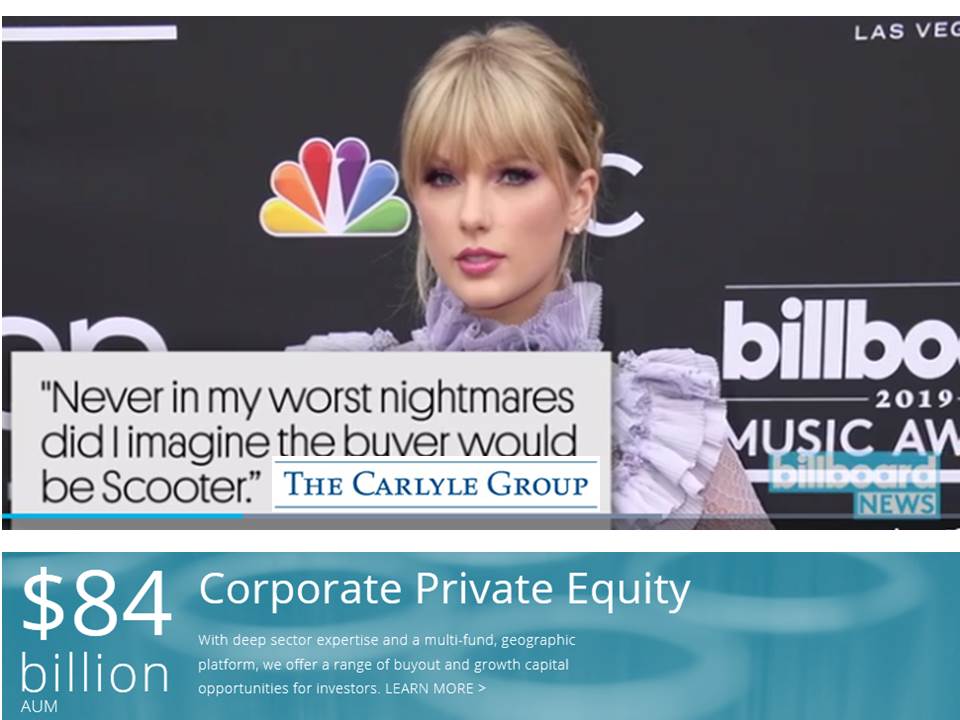
Carlyle Group Bullies Taylor Swift


Star musician Taylor Swift is "sad and grossed out" by Scott Borchetta and his deal with The Carlyle Group, a politically connected private equity underwriter (PEU).  Music Mayhem Magazine reported:

Ithaca Holdings LLC., a media holding company led by SB Projects founder Scooter Braun, and Big Machine Label Group, a leading independent record label founded by Scott Borchetta, announced today a finalized contract under which Ithaca Holdings will acquire Big Machine Label Group. 

The Carlyle Group, which initially invested in Ithaca in 2017, is supporting the transaction, alongside Scooter Braun and Ithaca Holdings, through an additional equity investment by way of its Carlyle Partners VI fund. Carlyle will remain a minority shareholder in Ithaca and continue to support the combined company’s growth strategy with Jay Sammons, Head of Carlyle’s Global Consumer, Media and Retail team, remaining on Ithaca’s Board.
Taylor Swift shared her concern that she had no opportunity to buy her music from Big Machine Label Group.  Her rich music library was valued and sold as part of a package deal.

Swift isn't alone in this regard.  The City of Missoula got stiffed by Carlyle on its public water system.  It took a court to rectify Carlyle's bullying of that municipality.

PEUs are ubiquitous in America today.  They own many a failing retailer.  Bain Capital and KKR ran Toys R Us into bankruptcy.  Lawyers earned $56 million and employees got a mere $2 million severance, which amounts to $60 per workers.

Taylor's recent PEU smear followed other music deals.  Billboard reported:

Ithaca’s action follows other Nashville moves by private-equity firms including Blackstone’s purchase of music rights organization SESAC in 2017 and Round Hill’s acquisition of publishing company Big Loud Shirt Industries in 2014. 
Greed is slimy and Swift should be grossed out:

"You hit those hurdles, earn-outs, what have you, and less people in the fund ask you questions or lean on you about where their returns are.  If you don’t hit those hurdles, you will be asked for more reports and more questions will come from an army of MBA’s and finance folks.” 

The PEU beat goes on.

Update 7-15-19:  Kelly Clarkson advised Taylor Swift to re-record her old works.  That would hurt Carlyle, which sold Getty Images for less than it initially paid.  In between Carlyle loaded Getty with debt which likely went mostly to the PEU owner.

Update 8-22-19:  Taylor Swift announced she would re-record her first six albums, potentially denting Carlyle's PEU investment.  Her aim is to "regain artistic and financial control of her material after her former record label sold it in a reported $300 million deal."

Update 11-17-19:  Bloomberg reported "Taylor Swift’s feud with her record label reveals a little-known fact about the entertainment business: the outsized role private equity plays in funding its biggest stars.Swift asked Carlyle Group in a tweet on Thursday to help her as she battles to secure ownership of albums she recorded with her previous label.  The pop star didn’t criticize Carlyle, only appealing for its help. But her conspicuous mention of the company put a spotlight on an industry her legions of young fans normally wouldn’t have reason to pay attention to. Google searches for Carlyle Group surged after her tweet."

Update 4-12-21:  Swift re-released her Fearless album.  Loyal fans are burying the old versions on Spotify.

Following Friday's midnight release of Fearless (Taylor's Version) — for which Swift re-recorded her music after failing to acquire the rights to her early albums two years ago — Swifties launched a campaign to bury the Big Machine version on Spotify.
Hopefully the unnamed investment firm can claw-back money from Ithaca and The Carlyle Group.  Taylor Swift, like the City of Missoula with Mountain Water, tried many times to buy back the rights to her music.


Friday, June 21, 2019

Explosions at Carlyle Group's Philadelphia Refinery

Three explosions rocked Philadelphia Energy Solutions (PES) refinery early this morning.  Philadelphia Inquirer reported:

A series of explosions ripped through a refinery in South Philadelphia early Friday, lighting up the night sky and triggering a massive fire.
Gasoline prices rose in the aftermath of the blaze.

Wholesale gasoline prices surged 3.7 percent Friday in New York on speculation that the PES outage might curtail regional fuel supplies.
PES went bankrupt in early 2018, after The Carlyle Group loaded the company with debt used to pay Carlyle massive dividends.  Carlyle tried to take PES public in August 2015 but low energy prices derailed the IPO.

Seeking Alpha explored the bankruptcy and was puzzled by the refinery's agreement with its former rail terminal, which received millions in public funding.

The Carlyle Group spent $175 million in 2012 to acquire a two-thirds stake in PES Holdings, but in return it had to obtain full operational control of the company. PES Holdings was in desperate need of a capital injection at the time in order to upgrade its operations and stay relevant in the refining space.
Under new management, PES Holdings spent $100 million building a rail terminal to receive Bakken crude and $30 million upgrading that facility. By 2015, North Yard Logistics LP was spun off and Carlyle Group decided to buy a stake in the spin-off.
So Carlyle was in full operational control and on both sides of the logistics deal, which it too planned to take public.  Investors don't want to buy a company that has an at risk revenue stream.  Carlyle shored up logistics revenue for North Yard/PES Logistics Partners:

North Yard Logistics LP signed a minimum volume agreement with PES Holdings, where PES agreed to take in 170,000 barrels of oil per day for ten years through that terminal. PES would pay North Yard $1.95 per day to load and unload those barrels, which is equal to a quarterly minimum payment of $29.835 million or an annual payment of almost $120 million. Loading and unloading fees above that volume would be only $0.51/barrel. There were also inflation escalators built into the contract.

During the first half of 2014, the rail terminal's utilization rate was nice and high at 91%, but that was back when it only had 140,000 bpd of capacity.

Various SEC filings provide different capacity figures, as PES Logistics Partners noted that the rail terminal's capacity was going to be increased to 210,000-240,000 bpd, while Energy Transfer Partners LP noted that capacity was going up to 280,000 bpd. It comes down to what types of trains are carrying the crude across America, newer trains means the terminal can offload larger volumes of crude per day.

PES Holdings' utilization of that rail terminal dropped precipitously from 2015 to 2017. Recently, its utilization rate has moved below 30% as PES has only been shipping in 58,000 bpd through the rail terminal. PES still has to pay $120 million per year to North Yard, but that will probably change post-bankruptcy.
PEU Report noted Carlyle's reliance on train shipped oil in early 2015.  Within nine months the picture changed and PES relied on African oil delivered by ship.


PES turbulent PEU ownership isn't over.  Carlyle lists the company as a current holding and promotes its ownership via a value creation video.  As in the case of nursing home giant ManorCare. Carlyle's value can be someone else's destruction.

Update:  ZeroHedge reported on the fire but missed the Carlyle Group ownership connection.

Update 6-26-19:  PES will permanently close its oil refinery (source Seeking Alpha)  PES has no news story on its website about the closure.  Philadelphia Inquirer said owners would position the refinery for a sale and restart.

Update 7-22-19:  ZeroHedge reported PES filed for bankruptcy for the second time in two years.  The Carlyle Group got not one mention in the story.

Monday, June 17, 2019

PEU View from Ground Floor


Twice I've worked for a private equity owned healthcare company.  The first time was in the early 1990's and the second started a year ago when the same private equity underwriter (PEU) obtained majority ownership of my employer (alongside another PE firm). The two experiences were night and day.

In the early 90's I received regular raises and bonuses.  I met one of the principals of the PE firm at a national meeting.  He seemed personable.  I had no concept of private equity.  I just knew we were privately owned and I bought stock in the company in our initial public offering (IPO).  Today that company's debt is rated CCC by Standard and Poors.

In the last year the same private equity firm oversaw the destruction of our office.  Turnover soared to over 50%.  Our new owners cut the number of holidays by 25% and reduced holiday pay by 33%.  They installed unreliable cloud technology and implemented time wasting software which also underpaid employees.  They cut 10% of the workforce as Christmas and New Year's approached.  Our office space was cut in half when they moved us to another location.

Management exhorted us to grow in the midst of this chaos.  We were asked to serve our customers with fewer computers (75%).  The phone is a primary means for us to serve existing and get new patients.  They cut the number of office phones by 71%.  Oh, and my first raise in years amounted to a paltry 0.5%.

The company grew EBDITA by over $50 million during this time.  The principal I met in the 90's is still with the firm.  He no longer seems personable.  Greed ruined a once great local provider.

The PEU virus is now epidemic in healthcare and I directly witnessed its devastating symptoms.  I'm not sure our healthcare system can recover from PEU toxicity.

Update 6-19-19:  ZeroHedge ran a piece on the managerial elite enriching themselves via complexity and obfuscation,  Author Charles Hughes Smith sees healthcare as a failed system that will bankrupt the nation.  His view echoes that of Dr. W. Edwards Deming who once called rising healthcare costs one of management's seven deadly diseases.