Sunday, March 8, 2015

Water Charges Garner Ire of Ireland


The long suffering Irish may finally rise up over water.  NYT reported:

Since the banking crash of 2008, they have borne big tax increases, severe cuts in public services, mass unemployment and the large-scale emigration of their children. A 2012 study by the International Monetary Fund found that Ireland was in the “undesirable position” of owning “the costliest banking crisis in advanced economies since at least the Great Depression.” And it was “still ongoing,” imposing a huge public debt and dire fiscal costs on Irish citizens.

Irish citizens are angry about having to pay for that which Mother Nature provides for free.  BBC News reported:

Raising money from water charges was a condition imposed on Ireland by the EU-IMF-ECB troika as part of the country's bailout in 2010 following economic collapse.

Should charging citizens for water involve the very same practices that contributed to the financial crisis?  Irish Times reported:

The Government has not been helped by Irish Water itself, an entity which seems to have gone out of its way to demonstrate that the lessons of the banking crisis have not been learned.
See if this sounds familiar (Irish Examiner):

Finance Minister Michael Noonan has admitted that €490m meant for local services is to be diverted into Irish Water.

Nearly 300 staff at Irish Water are entitled to bonuses of some €2.1m. Mr Martin said Irish Water was like a “secret service” until facts began to trickle out during the row over the €180m start-up costs, almost half of which will go on outside consultants. 

“The Taoiseach’s spokesman said the same, namely, that no bonuses would be paid. We then learned, yes, bonuses will be paid, that the Government approved the payment of bonuses, and that the Economic Management Council approved the structure of the establishment of Irish Water as a subsidiary of Bord Gáis, resulting in the reality of bonuses being paid.” 
It harkens Lehman Brothers after the crash, where executives got massive bonuses for driving their company into the ground and rhe Fed provided $138 billion in loans.  The financial crisis has a direct link to the Irish having their dander up over water (NYT):

There is a deep sense of injustice at being turned into one of the most indebted nations on earth in order to rescue international bondholders who gambled on rogue Irish banks. There is the way the pain has been inflicted most deeply on the poorest people — the last four government budgets have been regressive, hitting those on the lowest incomes hardest. There is the bitterness of yet again having to export the country’s greatest asset: its talented, highly educated young people.

Above all, there’s the gap between the Irish story and the Irish experience. The story is upbeat — austerity works. The experience is rather different.
How much did international bondholders, including Goldman Sachs, Barclays, Credit Suisse, HSBC, BNP Parnibas and others, benefit?  ECB President Mario Draghi stated in a letter dated February 17, 2015:

With proposals to gain in the region of €1.75 billion from burden-sharing with these bondholders, the ECB’s opinion was, and still is, that such gains were insufficient to warrant the risk of the unknown and unquantified costs of burden-sharing at a critical juncture in the Irish macroeconomic adjustment programme, given that the pillar banks had just been recapitalised and the system was being stabilised.
So bankers behaved badly and that same group, as holders of other banks notes, needed to be bailed out.  Irish people likely don't want to pay the price that bad actors never paid.

The stories of Lehman and Bear Stearns will undoubtedly remain in the annals of financial disaster for many years to come. To understand what has happened, and what lessons should be drawn, it is important to get the facts right. In contrast to what has been commonly assumed thus far, the top executives of those two firms were not financially devastated by their management of the firms during 2000-2008. They were able to cash out rather large amounts of performance-based compensation, both from bonuses and from share sale, during the years preceding the firms’ collapse. This cashed-out performance-based compensation was large enough to make up the losses on the executives’ initial holdings in the beginning of the period. As a result, the executives’ net payoffs from their leadership of the firm during 2000-2008 were decidedly positive.
There is gold at the bottom of an Irish rainbow.  It's the trickling water, which financial powers (who screwed things up to begin with) want monetized.   I can see why the Irish are angry.

Update 3-22-15:  Over 80,000 Irish citizens protested new water charges in Dublin. 

Burning Oil Train's Destination: Carlyle Group Refinery


Bloomberg reported:

A BNSF Railway Co. train carrying Bakken oil for Mercuria Energy Group Ltd. continued to burn in rural Illinois two days after it jumped the tracks.  Five of the BNSF train’s 105 cars remained on fire after Thursday’s derailment. 

Twenty-one of the train’s 105 cars, which include two sand cars as buffers, jumped the tracks Thursday afternoon near Galena, Illinois, about 160 miles west of Chicago. The U.S. Department of Transportation said 14 cars were in a pileup and half of those were punctured. Emergency responders evacuated a 1-mile radius, which contained six homes. 

From here we launch into the arena of high finance.  Consider the hauler, owned by Warren Buffett.

“An initial pool fire occurred that we believe impacted five rail cars and that fire continues to burn,” BNSF, a unit of Warren Buffett’s Berkshire Hathaway Inc., said Friday in a statement about the Illinois crash. “Local, state and BNSF Railway emergency personnel are on the scene working to contain the incident.” 
Local and state emergency personnel are generally taxpayer funded.  Recall how much America's billionaires hate paying taxes.


The next layer of finance is a Mediterranean commodity trader operating from Switzerland.

Mercuria, a Cyprus-based commodity trader, owns the crude and was working with the railway to investigate the accident, Matt J. Lauer, a Mercuria spokesman, said by telephone from Geneva. The oil was loaded at Bakken Oil Express LLC’s terminal in Eland, North Dakota, Joe Shotwell, operations director at the complex, said by phone on Friday. 

Mercuria was shipping the oil to Philadelphia Energy Solutions LLC’s refinery in Philadelphia, a person familiar with the situation said, while asking not to be identified because the information isn’t public. The company will work to fulfill the plant’s order with alternative supplies, the person said. 
Mercuria. which "is registered in Cyprus and has its main trading operations in Geneva", took over J.P. Morgan's commodities unit in October 2014.  What started as an announced $3.5 billion deal shrunk to $800 million by execution. 

The Carlyle Group owns Philadelphia Energy Solutions, which until recently employed J.P. Morgan's commodities unit for trading, inventory handling and logistics.  Carlyle contracted with Bank of America for working capital financing and hedging of price risk.  Carlyle's PES took over its own logistics and trading. It will be happy to take Mercuria's alternative supplies.

Philadelphia Energy Solutions recently expanded its ability to accept 280,000 oil barrels per day by train. That's 400 train cars a day, 146,000 per year.  PES IPO filing states:

Logistics has operated a crude oil rail unloading terminal with the capacity to unload four crude unit trains per day, or 280,000 bpd (the "North Yard terminal"), which provides certain logistics services to Refining. The North Yard terminal is located adjacent to the Philadelphia refining complex and is the East Coast's largest crude oil rail unloading terminal. The separation of our business into the refining and logistics segments provides flexibility in how we allocate capital and access capital markets, in order to balance the growth of our businesses and the return of capital to our stockholders. We intend to explore growth opportunities in both of our segments, either organically or through third-party acquisitions. These growth opportunities could include investments either upstream, downstream or within our current operations, including opportunities at the Philadelphia refining complex. Following this initial public offering, and subject to market conditions, in order to grow our logistics segment, we intend to explore an initial public offering of a growth oriented master limited partnership ("MLP") that owns a substantial portion of our logistics segment and that will be focused solely on providing logistics services to Refining and third parties (the "Logistics IPO"). 

"Intend to explore an IPO"?  It's well beyond that for PES Logisitcs.  Carlyle filed for a PES Logisitics IPO on 9-22-14 and has updated the filing twice since.  The refinery filing came on 2-17-15.

Despite the language stated above, which implies an investor might get part of the logistics segment, Carlyle is actively pursuing IPOs for both divisions. 


MLPs, like private equity underwriters (PEU), pay preferred tax rates.  First responders, be sure to remember Berkshire's Warren Buffet and Carlyle's David Rubenstein the next time a derailed oil car ignites into a fireball.  This is but one face of PEU profits over people. 

Friday, March 6, 2015

PEUs Feel Surge in Asset Prices: Time to Cheat?


The Sydney Morning Herald reported:

Private equity executives have identified surging asset prices as one of the biggest challenges confronting the industry in 2015, particularly as competition for assets remains fierce and globally firms have $US1.2 trillion ($1.5 trillion) in funds to deploy. 
This harkens back to the frothy days before the 2008 crash when private equity underwriters (PEU) colluded to reign in the very same surging asset prices.  

6-12-14:   Goldman, Bain Settle Private Equity Club Deal Lawsuit ($121 million combined) 7-11-14:   Silver Lake The Latest To Settle LBO Suit With $30M Deal ($29.5 million)

8-07-14:   K.K.R., Blackstone and TPG Private Equity Firms Agree to Settle Lawsuit on Collusion ($325 million)
9-08-14:   Carlyle Deal Concludes a Lawsuit Against Private Equity ($115 million)

The settlement totaled $590/5 million.  Carlyle passed the lawsuit costs onto investors, its limited partners.  PEU founders cheated and passed the costs onto customers.


Rest assured any future collaboration will take place under the protection of Chatham House rules, whether it be in Davos, at Bilderberg or any SuperReturn conferences.  E-mail will not be used. 

Despite earlier predictions surveillance will not be employed on the ruling class. Technology will provide protection for the collusion class.  The reason:  PEU political sponsors need funding and post public service employment

Wednesday, March 4, 2015

Carlyle Needs Oil Bottom for Backdoor Takeovers


CNBC interviewed Carlyle Grooup co-founder David Rubenstein on oil patch investments.  Yahoo Finance reported:

Carlyle Group's David Rubenstein told CNBC on Tuesday he is not waiting for oil to hit a bottom before investing in beaten-up energy companies.

"The great fortunes are usually made when prices are low. They're not usually made when you buy at the top and think they'll get higher," he said in a "Squawk Box" interview. "Prices are very low in energy, and a lot of people are scrambling, and that's where you make a lot of money."

Rubenstein has called distressed debt the single greatest new energy opportunity to invest," saying investors can by debt cheap and potentially take control of companies. 
Ask Brinton's founding family how that backdoor takeover went.  If oil companies conduct prepackaged bankruptcies with debt holders Carlyle must be at the table.  That means buying debt before the bottom, the triggering event that gives Carlyle the chance to pounce.  

Tuesday, March 3, 2015

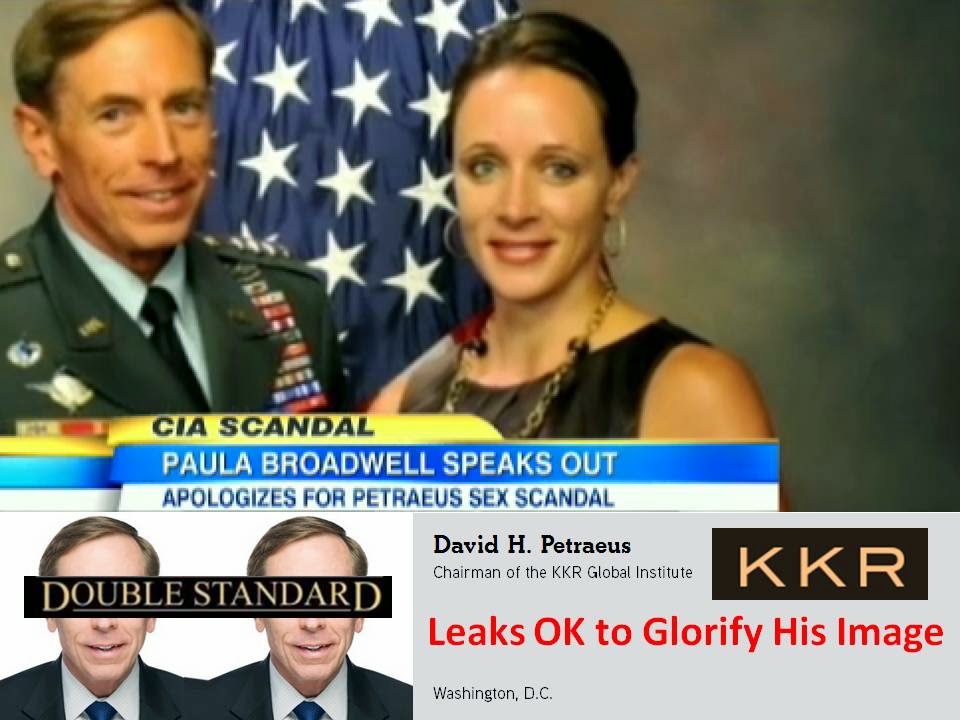
Petraeus Remains Free to PEU


ABC News reported:

Decorated war veteran and former CIA director David Petraeus has entered into an agreement with federal prosecutors in which he would plead guilty to a misdemeanor charge for mishandling classified information.

The charge, unauthorized removal and retention of classified material, stems, in part, from documents the former director allegedly provided to his mistress. 
The misdemeanor charge follows his words of contrition:

In addition, in a private letter to a friend two weeks after his (CIA Director) resignation, Petraeus wrote: “I screwed up royally. ... I paid the price, appropriately.”
He's paid virtually no legal price, just as his private equity underwriter (PEU) employer KKR pays virtually no taxes.  They are free to PEU together, thanks to President Obama's "Just Us" Department.

Update 4-23-15:  As expected Petraeus got off easy with two years probation and a $100,000 fine.  His leaks were to inflate his ego and help his concubine.  There were no higher ideals or desire to unearth injustice.  That's exactly what we have, injustice.   

Sunday, March 1, 2015

Ex-PEU Semiconducter Deal: NXP to Buy Freescale

Nasdaq reported:

NXP Semiconductors NV agreed on Sunday to acquire Freescale Semiconductor Ltd. in a combination that would create a chip giant with combined revenue of more than $10 billion.  

Private equity underwriters (PEU's) did leveraged buyouts on the two firms in 2006.  This was the period when PEU's did club deals to keep buyout prices down.  All the private equity firms charged in the collusion case settled out of court for nearly $600 million. 

After years of paying annual management fees and dividends to their PEU owners each company went public, NXP in 2010 and Freescale in 2011.  NXP's buyout of Freescale will be Carlyle and company's last chance for profit as PEU's hold 64% of Freescale's equity.

Robber Barons Game Tax Structure


Blackstone co-founder Steve Schwarzman took home five hundredths of one percent of his compensation in salary.  The rest of his $690 million in 2014 earnings is taxed at preferred, i.e. lower rates than salary.  Congress had eight years to reign in such obscenities, but instead catered to the PEU crowd.