Friday, August 16, 2019

Milken Publishes Reinhardt Chapter on Healthcare Costs


Milken Institute excerpted a chapter from Princeton Professor Uwe Reinhardt's posthumously published book, Priced Out: The Economic and Ethical Costs of American Health Care.  In 2013 Reinhardt said:

“Our hospitals spend twice as much on administration as any hospital anywhere in the world."
Reinhardt profited from excessive administrative costs via his stock ownership in Triad Hospitals, an operator of for-profit hospitals.


He received just over $2 million for his Triad shares.  Five years later Uwe got another $2 million from his Amerigroup shares


Reinhardt served on other for-profit healthcare corporate boards, including healthcare investment advisor Tekla. The Princeton professor profited handsomely from America's administrative cost heavy healthcare system.  That should be kept in mind as his work is considered. 

Thursday, August 15, 2019

CBS This Morning Offers PEU Rubenstein as Salve


The media called upon Carlyle Group co-founder David Rubenstein to calm investor fears the day after an 800 point fall in the Dow Industrial average.  CBS This Morning interviewed private equity underwriter (PEU) Rubenstein.

The greed and leverage boys loaded affiliates with huge debt, some of which fundied sponsor dividends.  PEU ownership causes 10 times greater bankruptcies over the decade long study period.

I've experienced PEU ownership again this last year.  Our greedy owners slashed staffing, cut benefits and eliminated many unique services that our customers appreciated.

Not one anchor challenged Rubenstein as a perpetrator of financial pain or a contributor to a looming recession  Carlyle Capital Corporation packaged mortgage backed securities and sold the investment as safe.  Debt loaded CCC was the canary in the coal mine for the Fall 2008 Financial Crisis.  Rubenstein's firm loaded CCC had 32:1 debt to equity.


Here's how one losing investor characterized Rubenstein's and Carlyle's sales pitch for CCC:

Carlyle "offered to sell shares of stock in the fund by knowingly or negligently representing that, among other things, the fund was 'conservative,' 'low risk' and that the 'downside [was] very limited."  Forbes, July 2009
Take anything the PEU boys say with a shaker full of salt.

Monday, August 12, 2019

PEU Ownership Leads to Affiliate Bankruptcies


An academic study found private equity underwriter (PEU) ownership carries financial risk:

Tracking a sample of 484 public to private LBOs for 10 years after going private, we find a bankruptcy rate of approximately 20%, an order of magnitude greater than the 2% bankruptcy rate for the control sample

Deal fees, management fees, dividend bleeding, debt bloating and asset stripping are signature PEU moves that drain valuable capital from affiliates and place them in a precarious financial position in any downturn.

Sunday, August 11, 2019

Carlyle's Rubenstein Interviews Sec. of State Pompeo


Two weeks after The Carlyle Group wagered on naval conflict by buying two shipbuilders Carlyle co-founder David Rubenstein interviewed Secretary of State Mike Pompeo, President Trump's chief diplomat.  The pair talked about a number of world hotspots that could erupt into war on the seas.


The Carlyle Group has a history of war profiteering and stands ready to do so again.  Diplomacy can take the world away from armed conflict or drive nations to war.

Pompeo made it clear he does his boss' bidding.  Fellow advisor Hawk John Bolton has met a war he didn't love.

Carlyle's tea leave reading says naval conflict is coming, something Mr. Rubenstein failed to disclose.

Update 8-15-19:   Bloomberg ran a piece promoting their show. 

Saturday, August 10, 2019

Epstein Kills Himself

Less than a month ago I surmised that Jeffrey Epstein would be killed in jail.  Official reports indicate that Epstein died at his own hand.  Fox News reported:

The death comes two weeks after the 66-year-old was placed on suicide watch after he was found nearly unconscious in his cell with injuries to his neck. At the time, it was not clear whether the injuries were self-inflicted or from an assault.

NBC News reported that Epstein was in his own cell at the time of his death and was no longer on suicide watch.
Jerusalem Post reported:

Routine guard check-ups that were supposed to occur every 30 minutes were not executed the night that Epstein took his own life, sources told Reuters

If the pimp dies do cases against john's go away?  Also, there is an estate to sue.  

Update:  A friend wrote "how can you manage to successfully keep Chapo in prison but not keep Epstein from killing himself?"  I smell another hollow Lessons Learned report.   

Update 10-16-21:  Jeffrey Epstein believed he could make a deal with prosecutors by revealing secrets about former presidents Bill Clinton and Donald Trump.  Trump was President at the time of Epstein's suicide in jail. 

Update 12-31-21:  A jury found Epstein accomplice Ghislaine Maxwell guilty of sex trafficking underage girls.  

Update 6-29-22:  Epstein associate Ghislaine Maxwell got 20 years for her crimes, however the powerful people who abused girls are yet to be named.

Update 11-12-23:  WilmerHale's settlement for JP Morgan for enabling Jeffrey Epstein's child sex trafficking prevents state Attorney Generals from bringing action against parties to the settlement.

Update 8-1-25:  After meeting with Trump's former lawyer and Assistant Attorney General Ghislaine Maxwell, Epstein's henchwoman, was moved to a cushier federal prison in Bryan, Texas.  

Wednesday, August 7, 2019

PEU Paladin to Close Philadelphia Safety Net Hospital


Philadelphia's employment situation will take a second private equity underwriter (PEU) hit with the announced closure of Hahnemann University Hospital and elimination of 2,500 jobs.  This follows Philadelphia Energy Solution's bankruptcy and plant closure with the loss of up to 1,000 jobs.   As more people in Philadelphia fall through the safety net there will be no hospital to care for them.


Hahnemann University Hospital entered bankruptcy after eighteen months of private equity ownership.  Paladin Healthcare and Paladin Capital purchased Hahnemann/St. Christopher's from Tenet Healthcare in January 2018.  A Tenet investor slide highlighted the deal.


Paladin Healthcare promised to be the long term solution for Hahnemann and its safety net clientele.


Tenet Healthcare owned and operated Hahnemann and St. Christopher's for the nineteen years.  For-profit hospitals invest in systems that provide reliable information on hospital finances.

Tenet's Chief Financial Officer's first CFO job within the company was at Hahnemann.


In early June 2019 Paladin asked for public dollars to keep Hahnemann going.  Contrast that development with lofty deal announcement language (just before Labor Day 2017).

"Paladin shares [Tenet's] commitment to providing compassionate, exemplary care and service, and we believe that entrusting the stewardship of these institutions to its affiliate AAHS will benefit the patients, employees, physicians and community for years to come," said Mike Halter, CEO for Tenet's Philadelphia division and CEO of Hahnemann University Hospital.

It never got to "years."  Hahnemann and fourteen fellow corporations entered bankruptcy June 30, 2019.  Center City Healthcare is the lead organization in Hahnemann's bankruptcy.

Hahnemann's 2,400 employees decried the hospital's planned closure, as did Philadelphia's Mayor and the Pennsylvania Governor.  Elected officials cited greed as a reason for Hahnemann's closure.

Paladin plans to break up the healthcare system and sell it in pieces. Modern Healthcare reported on aspects of the deal after it closed in January 2018.

American Academic and real estate investment firm Harrison Street Real Estate Capital, formed a joint venture to acquire a portfolio of four medical office buildings and a parking garage on the Hahnemann University Hospital campus, and the parking facilities at St. Christopher's Hospital for Children. American Academic has retained ownership of the hospital buildings, as well as one medical office building and two parking facilities.
It's not clear how much money Paladin pulled out of the Philadelphia healthcare system prior to bankruptcy.

The deal was financed with a $51 million loan from the investment firm Harrison Street Real Estate, and with a revolving line of credit from MidCap Financial, an affiliate of Apollo Global Management, one of the largest private equity firms in the country.

St. Christopher's was also paying monthly rent of $1.3 million to properties co-owned by Paladin's Freedman and Harrison Street.
Hopefully someone will garner that information in bankruptcy proceedings and share it with the public, especially if tax dollars are used to save the hospital.

Democratic Presidential candidate and Independent Congressman Bernie Sanders said about the closing:

“If you look at this thing objectively and you say that in the midst of a health care crisis, a hospital is being converted into a real estate opportunity in order to make some wealthy guy even more money, ignoring the health care needs of thousands of people, that is pretty crazy.”
Not in our PEU world where politicians Red and Blue love PEU.  It's standard practice.  CNN published information on the size and number of PEU healthcare deals.


Healthcare has been and is increasingly distorted by the greed and leverage boys.  The stories exist and many can be found on PEUReport (ManorCare, Lifecare, PPACA).. 

Tuesday, August 6, 2019

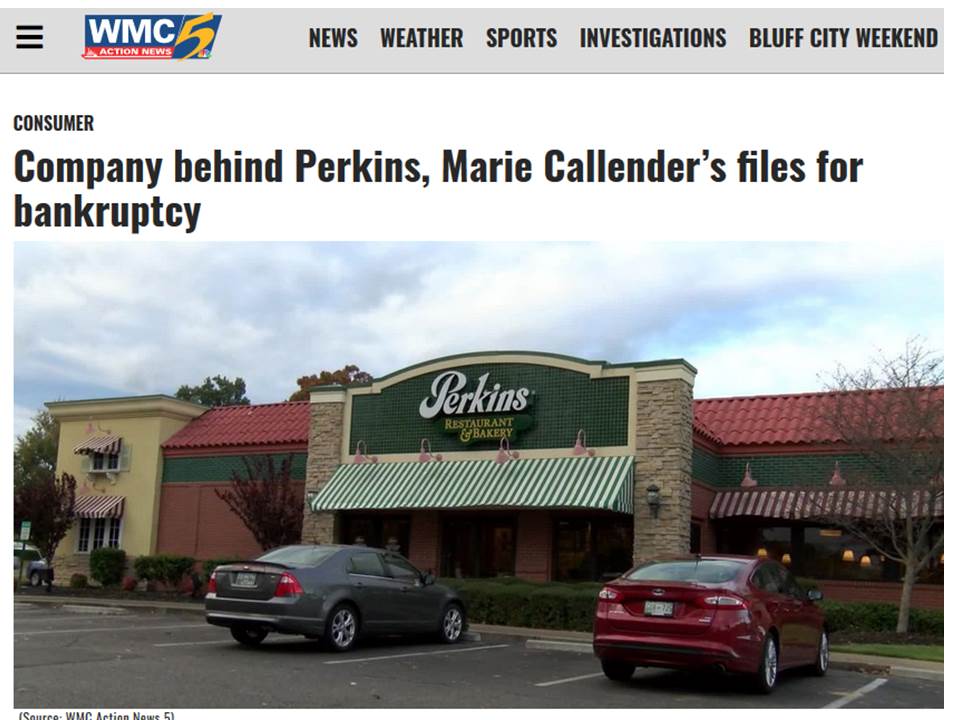
Latest PEU Bankruptcy Perkins Restaurant and Marie Callendar's


Restaurant Business reported:

The parent of the Perkins and Marie Callender’s family restaurant chains has filed for Chapter 11 bankruptcy protection in anticipation of selling the dual brands’ assets.

Perkins & Marie Callender’s also intends to close additional units, the court documents indicate. It recently shuttered 32 stores, according to media reports.
The company's press release makes no mention of its private equity owners, Wayzata Investment Partners.  Wayzata bought the company in 2011.


Perkins and Marie Callendar's had a total of ten corporations file for bankruptcy on August 5th, according to the Delaware Bankruptcy Court.  

How much did Wayzata take in management/deal fees and dividends/distributions since 2011?  What year did they hit free money in the company, i.e. when the cash pulled from the company exceeded Wayzata's initial equity investment?  I don't think even the bankruptcy judge would know the answer.